




Regulatory panacea works little to resuscitate investment and economic expansion as formal private credit growth stays almost stagnant in signs of prolonged slowdown in Bangladesh's private-sector-led economy.
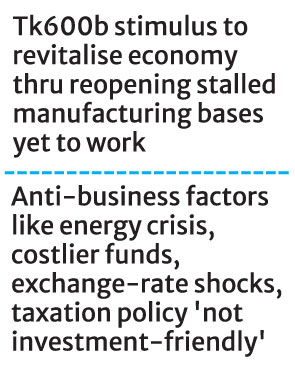
To breathe life into the $500-billion-plus economy after months of sluggishness, Bangladesh Bank (BB) has taken up numerous remedial measures, including a stimulus package involving Tk 600 billion to revitalise the economy by way of reopening the stalled manufacturing bases across the country,
But the stimulating regulatory moves have worked little to regenerate confidence in the private-sector players yet, as is reflected in the recent data with the central bank.
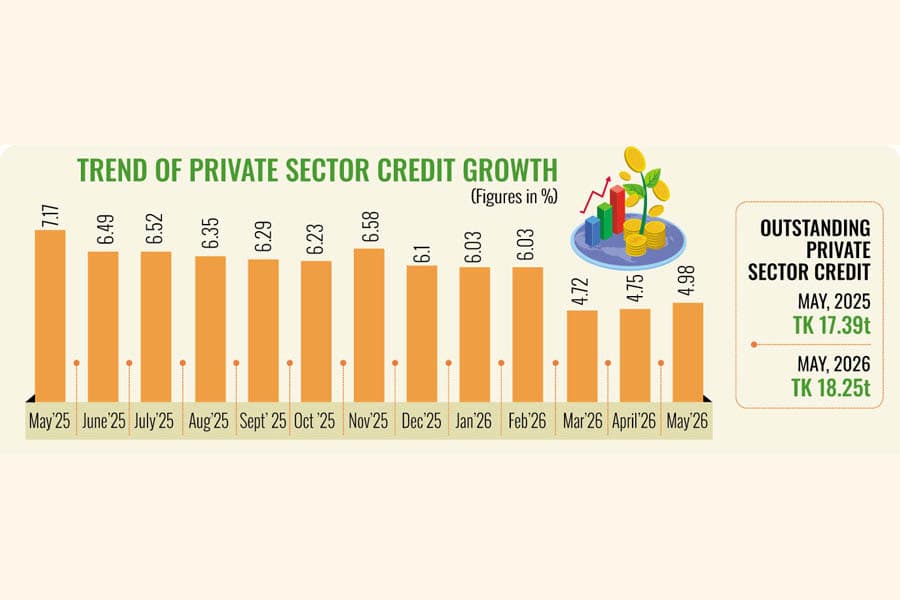
 According to the BB, the private-sector-credit growth reached 4.98 per cent by end of May last -- the third-lowest monthly count in the history of Bangladesh. The previous lowest growth recorded in the previous two months was 4.72 per cent in March and 4.75 per cent in April.
In fact, growth in private-sector credits has hovered around single digits since August 2024, reflecting prolonged sluggishness in the economy, which is largely private-sector-led.
Even in the just-concluded half-yearly monetary policy statement (MPS) for January-to-June period, the central bank made a private-sector-credit-growth projection at 8.50 per cent by end FY'26 but the actual level was much lower.
Such reluctance in investment credits is attributed to banks becoming more cautious amid higher non-performing loan (NPL) regime and private borrowers losing their credit appetite for perceived multiple anti-business factors, like energy crisis, higher cost of funds, exchange-rate shocks, and the existing taxation policy which is deemed not investment-friendly.
Seeking anonymity, a BB official says the regulator, as part of its plan to promote growth and employment, provided policy perks to the struggling borrowers by ways of allowing them to get regularized just paying 2.0 per cent of the outstanding loans as down payment.
Later, he recounts, the central bank eased the down-payment rules in February last as many of such borrowers were facing difficulties to pay 2.0 per cent. Under revised instructions, half of the stipulated amount must be paid at the time of approval, with the remaining 50 per cent due within six months from the date of effect.
"Despite these facilities, the credit growth for private sector has not got momentum yet," he says.
But the central banker appeared optimistic about a spur in the credit demand in the days ahead as the banking regulator announced the Tk 600-billion stimulus package in May last to boost investment.
Simultaneously, the BB official says, the central bank also capped deposit-lending rate spread within 4.0 per cent last month, which will help reduce the cost of formal credits for businesses amid contractionary monetary-policy regime.
While unveiling MPS for July-December of this year on June 30, BB Deputy Governor Dr Md. Habibur Rahman said the central bank projected the private-sector-credit growth to be increased to 5.50 per cent by June last.
President of Bangladesh Knitwear Manufacturers and Exporters Association (BKMEA) Mohammad Hatem says entrepreneurs have been hit too hard to survive on the market under these prevailing extreme business-and investment climate.
He lists multiple factors, like ongoing prolonged energy crisis, higher borrowing costs and 'anti-business taxation policy', which make survival of the businesspeople difficult.
"Under such circumstances, who dares think of business expansion? I don't know how the growth (4.98 per cent) has happened and who are the borrowers? Will they be able to repay the loans? I have enough doubt," he says.
Chairman of Bangladesh Association of Banks (BAB), an apex body of bank shareholders, Abdul Hai Sarker mentions many factors which discourage the investors from putting their hard-earned money in productive ventures.
He says the supply of power and gas to the industries is uncertain.
"By the end of the day, you need power. Everything will become standstill without this basic thing."
Mr. Sarker, a business leader and also Chairman of Dhaka Bank, says a concerning matter is that the government is facilitating foreign investment by developing special economic zones (SEZs) where investors are getting integrated facilities.
But, he adds, local investors who set up manufacturing bases outside the SEZs in a scattered way faced many difficulties in securing such facilities, which badly affected their competitiveness.
"Yes, we want foreign investment but the government should also look at the local investors so that they can remain competitive with their global partners," he told The Financial Express about perceived local-foreign divide.
Managing Director and Chief Executive Officer of Mutual Trust Bank (MTB) PLC Syed Mahbubur Rahman notes that the volume of LC (letter of credit) opening has dropped significantly in recent times because of persisting prolonged economic sluggishness.
Because of the low credit appetite from the private sector, he notes, the commercial banks have intensified their concentration on investing in state-secured government securities -- treasury bills and bonds -- to make some gains amid the ongoing slowdown in economic activity.
The experienced banker thinks the country is basically heading for stagflation as job creation is not taking place and growth is slowing down while inflationary pressure keeps rising.
Chairman of Policy Exchange Bangladesh Dr M Masrur Reaz says the private-sector-credit growth remains a matter of concern for the country for more than a year whereas the growth was over 6.0 per cent.
"Now, it dropped below 5.0 per cent. It goes to severe worrying level from concerning level," he notes.
About the reasons, the economist says Bangladesh under the immediate- past interim government saw scanty reform activities in streamlining trade-and-investment ecosystem here.
As a matter of fact, the business environment significantly weakened in recent times and the recent
crisis in the Middle-Eastern countries worsened the situation further,
according to him.
jubairfe1980@gmail.com