




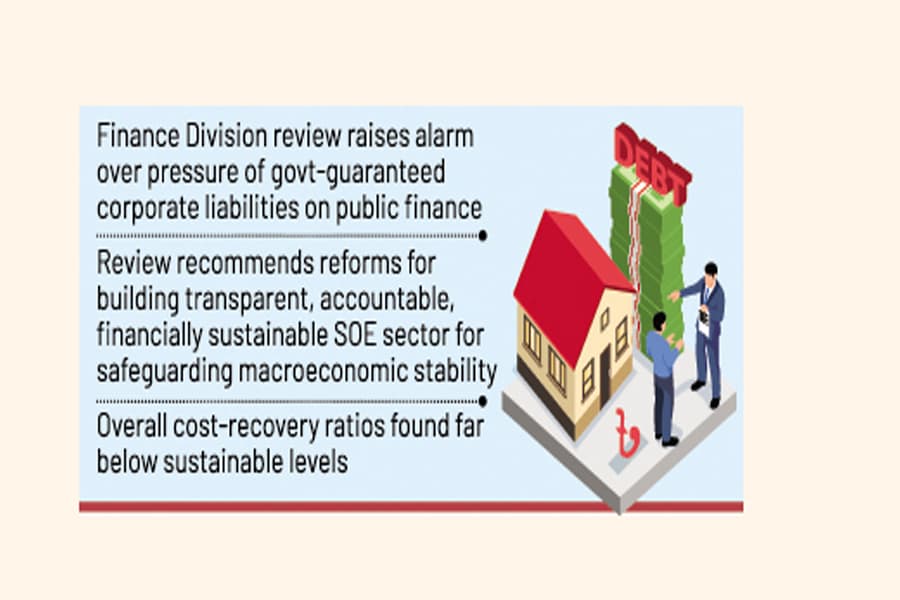
Government authorities have identified 19 of the state-owned enterprises (SOEs) that are posing a "very high financial risk" with a combined liability burden of Tk 2.2238 trillion.
A recent assessment by the Ministry of Finance (MoF) has dug out the downside of the public-sector corporates, underscoring urgent reforms.
The findings signify mounting fiscal pressures from the country's public corporate sector while the government finds it difficult to make two ends meet in financing national budget.
A review, conducted by the Finance Division, has found many an SOE financially vulnerable despite their strategic importance to the economy.
Bangladesh currently has 122 state-owned enterprises operating across key sectors, including energy, transport, manufacturing, SME development, and public services.
Bangladesh Power Development Board (BPDB) accounts for the largest share of liabilities, with an outstanding debt buildup worth Tk 1.784 trillion. Also in the power sector, Gas Transmission Company Limited (GTCL) carries liabilities of Tk 141.31 billion.
The review has found the financial performance of many SOEs sliding continuously, with overall cost-recovery ratios remaining far below sustainable levels.
Operating revenues are insufficient to fully cover operating costs, while returns on assets and equity remain persistently low, reflecting weak operational efficiency and limited financial viability.
The assessment has also highlighted sizeable contingent liabilities amounting to Tk 345.42 billion.
These represent debt obligations for which the government has provided sovereign guarantees to domestic and foreign lenders.
"Should the borrowing entities fail to meet their repayment obligations, the government would be required to assume responsibility for the liabilities, increasing fiscal risks," the review report cautions.
In addition to loan guarantees, many SOEs continue to rely on substantial budgetary subsidies to sustain operations that further builds up pressure on public finances.
The Finance Division recognizes that SOEs play a critical role in supporting economic development, delivering essential public services and advancing strategic national objectives.
Several of the enterprises contribute directly to energy security, food security, infrastructure development and trade facilitation, making them integral to the country's long-term development agenda.
However, the ministry warns that persistent financial weaknesses across a number of enterprises require continued monitoring and sustained policy attention for a redress.
Without structural reforms, the deteriorating financial position of loss-incurring SOEs could increase fiscal vulnerabilities and reduce the government's capacity to allocate resources to other development priorities.
The report stresses that strengthening corporate governance, enhancing operational efficiency and improving financial sustainability should remain key priorities for policymakers. It says better financial management, stronger accountability and improved commercial performance would help maximise the public value generated by state-owned enterprises while containing the government's fiscal exposure.
The Finance Division adds that building a transparent, accountable and financially sustainable SOE sector is essential for safeguarding macroeconomic stability.
"A stronger public-enterprise sector," it recommends, "would contribute to greater economic resilience, support inclusive growth and help Bangladesh achieve its long-term sustainable- development objectives while reducing the burden on the national budget."
jasimharoon@yahoo.com