


Bangladesh Bank continues its contractionary monetary-policy stance with the existing elevated policy rate unchanged to curb inflationary burden though some of its recent decisions raised questions over regulatory tightfistedness.
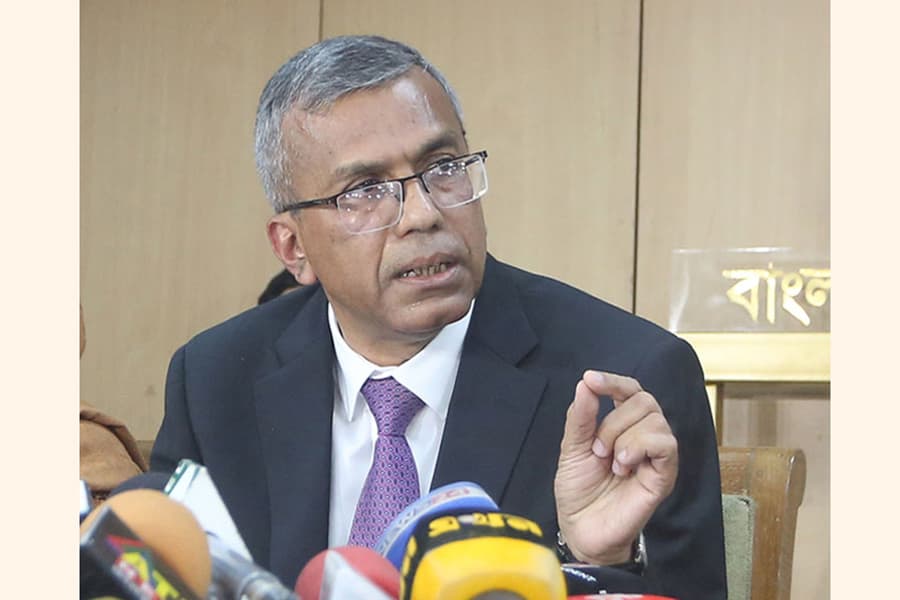
The central bank's governor, Md. Mostaqur Rahman, Tuesday unveiled the monetary policy statement (MPS) for July-December period of the new financial year of 2026-2027 at a press conference at its headquarters.
 Following comprehensive stakeholder consultations, BB has decided to maintain the policy repo rate at its current level for the immediate term. Concurrently, the central bank remains committed to a flexible, market-determined exchange-rate regime to strengthen external resilience, bolster export, and maximise remittance inflows.
Under such conditions, the central bank will keep its contractionary monetary-policy stance through the first half of FY27 (H1FY27) to rein in headline inflation and anchor long-term inflation expectations.
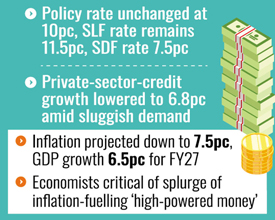
Accordingly, the policy rate will remain unchanged at 10.0 per cent. The Standing Lending Facility (SLF) rate will remain at 11.5 per cent and the Standing Deposit Facility (SDF) rate will be 7.5 per cent respectively.
Under the half-yearly MPS, the banking regulator has lowered its private-sector-credit-growth projection to 6.8 per cent by the end of December next, against the backdrop of sluggish demand.
As per the latest MPS, actual credit flow fell far short of that projected target with growth slowed to 5.0 per cent as of May last, as banks turned increasingly cautious amid rising loan defaults and economic uncertainty.
The growth of reserve money, euphemistically called high-powered money, is projected at 7.50 per cent and 11 per cent by end of coming December and June next year.
Monetary experts have raised question about achieving the projected target as the reserve-money growth rose to 14.39 per cent in April last from a negative growth of 0.12 per cent recorded in June last year.
The Bangladesh Bank has set a 7.5-percent inflation ceiling and targets 6.5-percent GDP growth for FY27, aligning with the government budget, according to the monetary policy statement.
At the MPS-rollout event, Governor Mostaqur Rahman said they want to bring vibrancy in economic activities in the country through bringing back confidence of the private sector.
To directly counter the private-sector-credit crunch and stimulate economic recovery, he says, BB has already unveiled a Tk600-billion stimulus package targeting struggling industries, agriculture and CMSMEs.
He mentions that the banking regulator very recently capped interest-rate spread within 4.0 per cent for all categories of loans save credit cards and consumer lending as they observed many banks widened the gap between lending and deposit rates by raising lending rates more sharply than deposit rates. "That's why we introduced the cap on intermediation spread so that both depositors and borrowers can be benefited."
Responding to criticism over repeatedly providing relief to defaulters, Governor Rahman says there was criticism regarding previous loan packages. They reviewed those criticisms. There may have been shortcomings, which is why the expected results were not achieved.
"This time, we have imposed many conditions. Not every closed company will qualify for loans. Those facing fuel, electricity, or gas shortages will not be eligible because they are unlikely to recover."
Only companies suffering from financial constraints, with good prospects for recovery, will be considered by banks for financing.
However, economists hail the central bank's move to continue higher policy rate, raising some critical questions over regulator's recent decisions which undermine the spirit of contractionary monetary-policy stance.
Chairman of Policy Exchange Bangladesh Dr M Masrur Reaz says the monetary-policy stance is tight on paper but it is not tight in reality because growing volume of money the regulator is injecting into the market in various regular and irregular instruments.
Terming the recent capping of interest-rate spread a counterproductive move, he says, "This may help allow the borrowers to get credits at lower costs from the lending entities."
On the other hand, he notes, quasi-fiscal activities by the BB continue growing, which is "another concerning issue as borrowers can avail subsidised credit through various refinance and pre-finance schemes".
Director-General of Bangladesh Institute of Bank Management (BIBM) Dr Md. Ezazul Islam says the monetary policy is not tight enough despite higher policy rate because of growing cash-feeding, liquidity support to commercial banks.
"Look at the reserve-money scenario. It is growing alarmingly and it needs to be controlled immediately to contain inflation," he told The Financial Express.
jubairfe1980@gmail.com