

Celebrated artist, puppeteer and television pioneer Mustafa Monwar has been laid to rest at Banani Graveyard after thousands of admirers, colleagues and cultural figures paid their final respects.
He was buried at around 3:30pm on Tuesday, his son Sadat Monwar told bdnews24.com.
Earlier in the day, his body was taken to the Channel i premises in Tejgaon, where colleagues and well-wishers paid tribute before his funeral prayers.
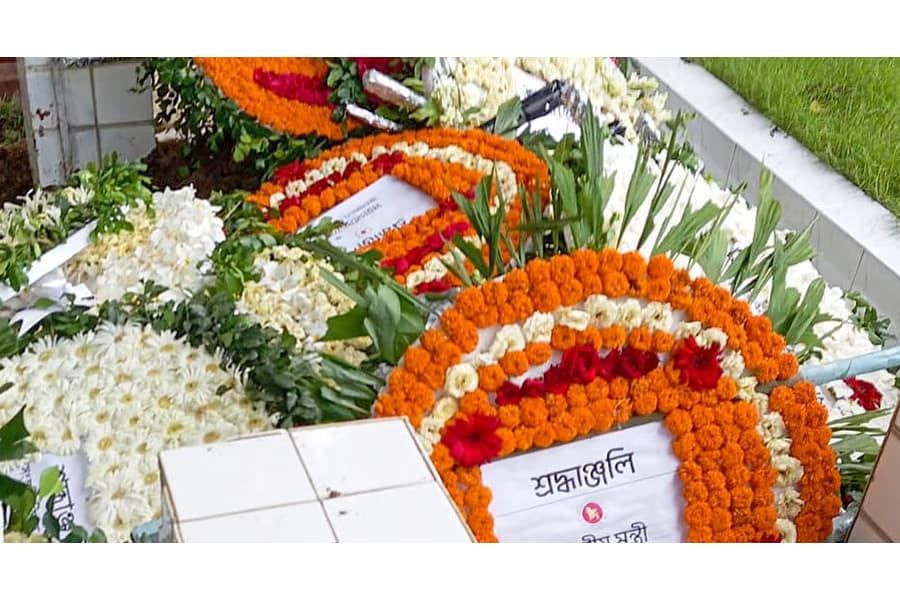
His final farewell began in the morning at Bangladesh Television in Rampura, followed by public homage at the Central Shaheed Minar.
Artists, academics, political leaders and representatives of cultural organisations gathered at the Shaheed Minar, where Monwar was accorded a guard of honour before his body was taken to the central mosque of Dhaka University for another funeral prayer.
His final stop was the university's Faculty of Fine Arts, where he had taught for years after returning from India at the invitation of Zainul Abedin.
Monwar died at the age of 91 on Monday morning while undergoing treatment at a private hospital in Dhaka after a prolonged illness.
Shaped by the Language Movement
Born on Sept 1, 1935, in Jashore, Monwar developed a passion for art, photography and Bengali culture from an early age.
As a school student, he drew cartoons inspired by the Bengali Language Movement, an act that led to his imprisonment for about a month under the Pakistani authorities.
After completing school, he studied at Government College of Art and Craft in Kolkata, graduating first in his class in fine arts in 1959.
During his time in Kolkata, acclaimed filmmaker Satyajit Ray praised his paintings for their ability to "say so much with very little effort".
Cultural Resistance during the Liberation War
Monwar joined Pakistan Television's Dhaka centre in 1965, leaving academia to help promote Bengali culture through television.
In the tense days before the Liberation War, colleagues and he ensured the Pakistani flag was not broadcast on Pakistan Day by extending programming past midnight into Mar 24, 1971.
That same month, he directed the broadcast of the patriotic song “Sangram Sangram Sangram, Cholbe Din-Raat Abiram”, written by Fazle Khoda and composed by Azad Rahman.
Although performed by only 10 singers, the production gave viewers the impression that hundreds of voices were singing together.
His contributions to television included adaptations of Rabindranath Tagore's Raktakarabi and William Shakespeare's The Taming of the Shrew, both of which were selected by Granada Television for its World History of TV Drama project.
He also created BTV's long-running children's talent show Notun Kuri and designed Mishuk, the mascot of the second SAFF Games.
During the 1971 Liberation War, Monwar joined a cultural troupe formed in Kolkata by Waheedul Huq and Sanjida Khatun, performing patriotic songs during Bangladesh's struggle for independence from Pakistan.
The suffering of children in refugee camps deeply affected him. To bring them comfort, he organised puppet shows in the camps, using storytelling and performance to ease the trauma of war.
Pioneer of Puppetry and Television
Monwar went on to transform puppetry into a recognised art form in Bangladesh, earning the nickname "Puppetman".
He introduced the art form to new generations through television and live performances.
His puppet character Parul later inspired the creation of UNICEF's Meena character, while his television puppets Bagha and Meni became household favourites.
Throughout his career, Monwar also served as deputy director general of BTV, director general of the Bangladesh Shilpakala Academy and the National Institute of Mass Communication, and managing director of the Bangladesh Film Development Corporation (FDC).
He was awarded the Ekushey Padak in 2004 in recognition of his outstanding contributions to art and culture.