


Corporate-tax incentives are broadened in the Finance Act 2026 by extending a 2.5-percentage-point rebate for a slew of businesses while retaining the existing 20-percent tax on dividend incomes of corporates.
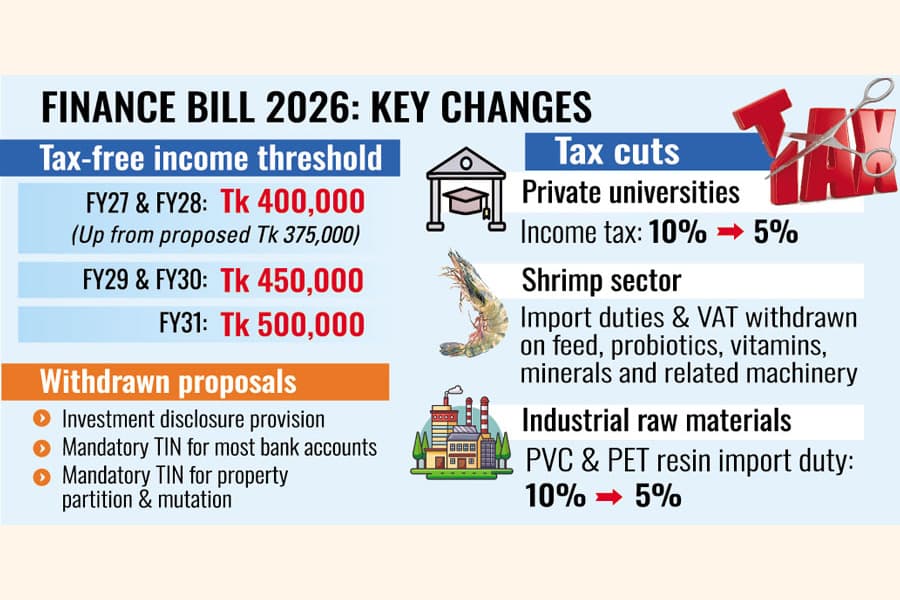
No taxing of retailers and no black-money-whitening scope either in the new budget while income-tax threshold rises to Tk0.4 million at the prime minister's request as parliament Monday passed the Finance Bill with such major amendments.
The Finance Bill, which ratifies government's fiscal proposals, expands the scope of the tax rebate for companies that conduct all their business transactions through the banking system.
Previously, the cut-down corporate-tax rate was available only to certain listed companies. The benefit now extends to other eligible businesses.
"The move is aimed at encouraging businesses to use formal banking channels and mobile financial services (MFS) in order to improve financial transparency and promote digital financial transactions," says tax-expert Lutful Hadee, a noted accounting professional.
However, he notes that the condition requiring all business transactions to be routed through banks may be difficult for many enterprises to meet because of the country's still-developing digital-payment infrastructure.
He suggests allowing a reasonable proportion of cash transactions while retaining the tax benefit as he thinks such flexibility would make the incentives more practical and effective.
Income Tax Policy First Secretary Md Jafor Imam says the facility would be available to companies currently taxed at rates ranging from 22.5 per cent to 27.5 per cent, meant for publicly-listed and non-listed companies both.
"However, companies enjoying special tax rates on the basis of nature of their businesses will not be eligible for the rebate," he adds.
On abolition of the existing 20-percent tax on dividend income earned by corporate entities, Mr Hadee says the current tax treatment will remain unchanged, easing concerns among institutional and corporate investors who had opposed the proposed revision in the bill.
The legislation also expanded tax incentives for listed companies by bringing Repeat Public Offerings (RPOs) under the existing tax-benefit framework, alongside Initial Public Offerings (IPOs) and Direct Listings.
Under the revised provision, listed companies raising capital through RPOs will be eligible for the tax incentives if they increase public shareholding to at least 10 per cent of their paid-up capital. The measure is expected to encourage greater free float and help deepen the country's capital market.
The government has also introduced a flat 15-percent tax on dividend incomes of individual taxpayers.
Finance Minister Amir Khosru Mahmud Chowdhury moved the Finance Bill 2026, which was passed by voice vote, with Speaker Hafiz Uddin Ahmad, Bir Bikram, in the chair.
Under the Finance Bill, placed in parliament on June 11 along with the 2026-27 national budget, such dividend income was proposed to be taxed at a flat rate instead of being added to total taxable income and taxed according to the applicable income-tax slabs.
The new measure is expected to reduce the tax burden on individual investors and encourage greater investment in the stock market. Other major amendments to the Finance Bill include the withdrawal of the proposed specific VAT for small and retail businesses, a reduction in the tax rate for private universities to 5.0 per cent and withdrawal of the proposed mandatory requirement for obtaining Taxpayer Identification Number (TIN) to open bank accounts.
The bill also provides for tax exemptions on salary income for indigenous communities living in the three hill districts and the plains both, in addition to existing exemptions on income from business, agriculture, and other economic activities.
Furthermore, customs duty, regulatory duty, supplementary duty, and VAT on imported shrimp feed, probiotics, vitamins, minerals, other essential inputs, and related machinery have been withdrawn.
The government has also reduced the import duty on PVC and PET resin-widely used industrial raw materials-from the proposed 10 per cent to 5.0 per cent, providing relief to domestic manufacturers.
doulotakter11@gmail.com