


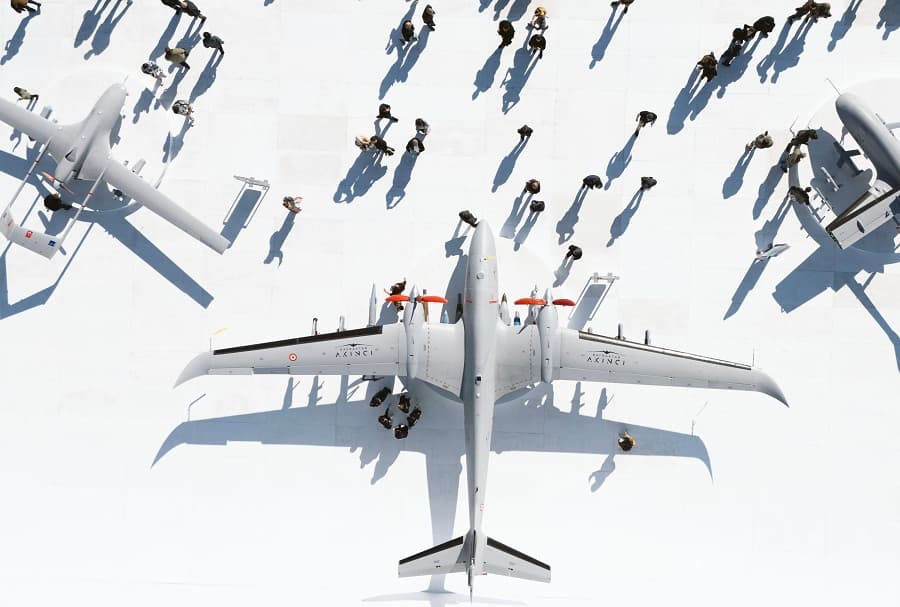
The world has been going through two phases of dramatic change; one is after the post-Cold War period, which is mostly dominated by the liberal international order and technological advances. And another one can be traced to the Russia-Ukraine war, which is known as the largest protracted conflict, where new technology, non-polarity, and coercive force have been seen; it can be reframed as a new age of war.
The new age of war is nothing but the absolute use of technological advancement with human cooperation, which may pose one of the biggest challenges for some and introduce new tactics for the coming war period. And, by my assumption, the world will be trapped in this new era of conflict.
In the recent U.S.-Iran war, the U.S. controlled the skies and carried out more than 13,000 strikes. But what is surprising is that a strong coercive approach did not stop Iran from fighting back. It launched more than 2,200 missiles and 4,400 drones.
At least eight U.S. aircraft were destroyed or damaged. Several U.S. radars were hit, and seven U.S. service members were killed.
On top of that, they even take strong control over the Strait of Hormuz, one of the most important sea routes in the world. The equation from this short-term war is clear: even though the U.S. is way more powerful, it failed to attain its goal.
The question is: what made the U.S. stay in that war so long?
Looking back, the U.S. had stealth aircraft, precision-guided weapons, satellites, and GPS. But these days, the trend and tactics of war have changed significantly with the advent of new technologies, such as war drones. And with these spreading around the world, a single monopoly over them is no longer possible.
Smaller countries are becoming dangerous with cheap drones; even some non-state actors may follow the same approach to achieve their goals. The world needs to prepare for it, especially the less developed countries.
In this new age of war, drones are becoming a key player.
In Ukraine, cheap sea drones and missiles badly damaged Russia's Black Sea Fleet. Ukraine sank many Russian ships as well.
No matter what and how powerful a country is, it needs to update its war tactics. The military needs more than aircraft, ships, and tanks.
It also needs data, computing power, and strong AI systems.
It must learn how to use these tools properly in real military operations. War culture needs to be changed and updated. The tools of war that were once useful in the 1990s no longer work.
Cheap drones are now available to almost everyone, everywhere.
For instance, Iran, becoming a major producer of these cheap drones, has supplied drones to Russia to support them; later, Russia built many based on their models.
Ukraine has become a testing ground for advancing this technology. Some Ukrainian drones can navigate autonomously during the final phase of an attack if enemy jamming cuts the connection to the human operator. Some long-range Ukrainian drones can fly up to 600 miles and navigate without GPS by comparing camera images with stored satellite images.
It is important to remember that these technologies will spread beyond the ground forces of Iran, Ukraine, and Russia. Other countries or armed groups previously mentioned will adopt them, which can keep them operating when communications and GPS are blocked. In the future, drones will be able to search large areas, locate targets, and attack them with little or no human control.
Today's simple drones may become tomorrow's intelligent drone swarms. Thousands of drones may work together, react quickly, and adjust to battlefield changes. These swarms could hunt moving targets, attack multiple locations simultaneously, overwhelm defences, and create communication or supply networks that are difficult to destroy.
Human pilots cannot match the speed and coordination of autonomous drone swarms. To use drone swarms properly, militaries will need to rethink command and control.
Soldiers will not manually pilot every drone. Instead, they may command hundreds or thousands of drones at once. The drones will coordinate many actions independently.
Military practices and tactics need to be privatised in collaboration with AI companies to improve their effectiveness in war zones.
While developed countries can easily replicate successful strategies by observing one another, developing countries face different challenges. But for developing countries, where wars these days tend to be long and drawn-out, they also need to be prepared, whether for regional autonomy or to protect their sovereignty. They need to coordinate with other countries or companies and, to some extent, fund institutions to develop and prepare for this new wave of warfare in the current era.
Mr Md Imran Hosen is a researcher, he can be found at mdimran-2020512459@ir.du.ac.bd