


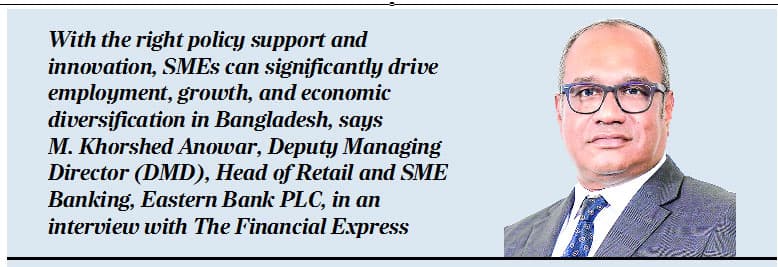
The banker narrates entire spectrum of vast prospects and soluble ways concerning the small and medium enterprises. In his view, SMEs are the economic backbone in the context of Bangladesh's standing in development. Also, he lists their innovative banking products and simplified client-funding procedures meant for making the sector grow to its full potential.
Following are the excerpts:
Q: How do you assess the importance of the SME sector in Bangladesh's economy? How significant is its contribution to employment generation and economic growth?
A: The SME sector is a key driver of Bangladesh's economic growth, supporting entrepreneurship, employment generation, and inclusive development. SMEs contribute significantly to GDP, at around 25 per cent, and generate a major share of employment at around 85 per cent, particularly for rural entrepreneurs, youth, and women.
The sector also promotes industrial diversification, poverty reduction, regional development, and innovation. Considering Bangladesh's priorities of job creation, private-sector growth, and economic diversification, SMEs will continue to play a vital role as a backbone of sustainable economic development.
Q: What types of loans, financial services, or special facilities is the Eastern Bank currently offering to SME entrepreneurs? Have there been any recent initiatives introduced in this regard?
A: Eastern Bank PLC (EBL) offers a wide range of SME financing solutions including working capital, business expansion, fixed asset, start-up, women entrepreneur, and sector-specific loans. EBL provides both secured and unsecured financing from TK 0.1 million to TK 250 million, along with trade-finance support.
Currently the EBL is focusing on cash-flow-based unsecured SME lending, commercial premises financing at competitive rates. The bank recently organised entrepreneur- development initiatives under the Skills for Industry Competitiveness and Innovation Program (SICIP) supported by Bangladesh Bank, the Ministry of Finance, and the Asian Development Bank (ADB). EBL also promotes women entrepreneurship, financial inclusion, and SME growth through capacity-building programmes, targeted campaigns, and competitive-financing solutions.
Q: What is the current status of loan- repayment rates and non-performing loans (NPLs) in the SME sector? Could you please draw an analogy in the risk and recovery situation between SMEs and large corporate loans?
A: Due to recent global and domestic economic challenges, some sectors have experienced pressure. However, overall, the SME- lending sector remains promising. Our experience shows that through regular monitoring, close communication with customers, and timely support, default risks can be significantly controlled. We are striving to maintain a healthy loan portfolio through responsible lending practices and effective supervision. As a result, our non-performing loan (NPL) position remains comparatively satisfactory within the industry.
SME loan repayment is largely dependent on regular business turnover and cash flow, while corporate loan repayment is driven by project cash flows, profitability, and broader business cycles. SMEs often face challenges due to limited formal accounting records, lower collateral coverage, and less-structured financial reporting compared to corporates. However, SME loan recovery can be relatively faster due to smaller ticket sizes and simpler recovery processes, whereas corporate loan recovery may take longer due to legal procedures, restructuring, asset disposal, and larger outstanding exposures.
Q: Many SMEs face difficulties in accessing finance due to collateral requirements, documentation, and formal procedures. What measures do you think are needed to reduce these barriers?
A: Many SMEs face challenges in accessing formal financing due to limited collateral, inadequate documentation, lack of formal accounting practices, and lengthy loan-processing procedures. To enhance SME financing accessibility, initiatives such as cash flow-based lending, simplified documentation and approval processes, dedicated SME relationship management, entrepreneur capacity building and expanded refinance and support programmes can play a significant role. In addition, greater adoption of digital access can help accelerate the loan-application and-approval process.
Q: Does EBL have any special plans or financial products for start-ups, women entrepreneurs, young entrepreneurs, and rural SMEs?
A: Eastern Bank PLC has established a notable presence in promoting and facilitating start-up financing in Bangladesh. To date, several prominent start-ups, including ShareTrip Limited, Zantrik Limited, Agroshift Technologies Limited, Shikho Technologies Bangladesh Ltd and Wander Woman, among other reputed enterprises, have availed start-up financing facilities from EBL. In line with Bangladesh Bank's Start-up Financing Guidelines, the bank has enhanced its financing limit to further expand support within this segment.
Moreover, for women-owned and women-led enterprises, EBL offers 'EBL Mukti', a dedicated SME financing solution under its Women Banking initiative, providing financing at a very lower interest rate of 5.0 per cent (under refinancing scheme) with simplified documentation requirements. The bank is also leveraging its extensive sub-branch and agent-banking network to extend financial services to rural and underserved entrepreneurs across the country.
Q: What initiatives is EBL taking to make SME financing easier through digital banking, agent banking, fintech, or technology-based services?
A: EBL has simplified SME financing through digital banking, agent banking, fintech-based solutions, and technology-driven services. Key initiatives include digital-banking platforms, EBL Skybanking, e-commerce solutions, agent banking, supply-chain financing, and E-Loan facilities to ensure faster, easier, and more accessible credit support for SME customers.
Q: In the next five years, what do you see as the biggest opportunities and challenges for Bangladesh's SME sector?
A: Over the next five years, Bangladesh's SME sector is expected to experience significant opportunities alongside notable challenges. On the opportunity side, key drivers include the rising growth of youth and women entrepreneurship, continued policy and regulatory support from the Government of Bangladesh and Bangladesh Bank, rapid expansion of the digital economy, and increasing prospects for import and export diversification and integration into global value chains. At the same time, the sector is likely to face several challenges, including pressure from high non-performing loans and others.
Q: What kind of coordinated efforts are needed from the government, regulators, and financial institutions to further strengthen this sector?
A: A coordinated effort among the government, regulators, and financial institutions is essential to strengthen the SME sector. The government should ensure policy stability, SME-friendly infrastructure, and a long-term development strategy. Bangladesh Bank can support through flexible lending frameworks, improved credit- information systems, and refinance facilities. Financial institutions should focus on innovative products, digital solutions, and efficient financing support for SMEs.
Q: What policy reforms do you think are most urgently needed to accelerate SME growth and improve their access to finance in Bangladesh?
A: Urgent policy reforms required to accelerate SMEs growth include creating greater awareness among SME entrepreneurs, strengthening SME credit-guarantee mechanisms, developing digital credit infrastructure, promoting SME formalization, and expanding refinance and targeted financing schemes. Encouraging fintech-based lending solutions will further improve access to finance and support sustainable SME growth.
Q: Your final thought in brief.
A: SMEs are the backbone of Bangladesh's economy and require sustained, inclusive support to unlock their full potential. Strengthening access to finance, technology adoption, and market linkages will be key to their long-term competitiveness. With the right policy support and innovation, SMEs can significantly drive employment, growth, and economic diversification.
saif.febd@gmail.com