


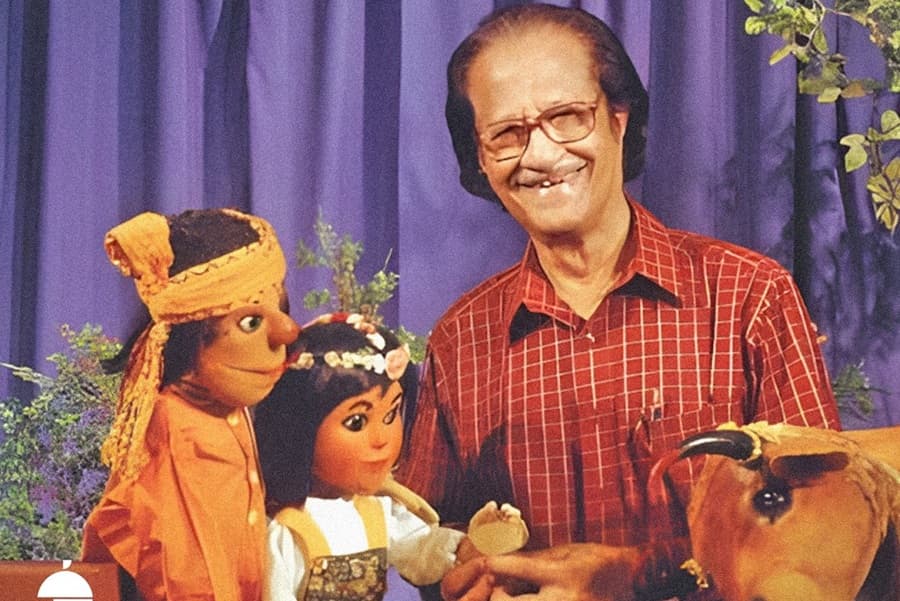
Mostafa Monwar died on Monday morning at Square Hospital in Dhaka, where he had been under treatment since mid-June for a pneumonia infection that wore down a body already worn down by age. He was ninety, and the family attributed the death to age-related complications rather than any single cause.
Back in the time, the puppet stage in 'Moner Kotha' was never quite big enough for its own ambitions, slightly too bright under the studio lights, a girl named Parul going back and forth with a baul singer and a buffalo who agreed with neither of them on principle.
In the earliest episodes, Monwar performed as a puppet figure himself; later, he appeared as himself, and Parul, Baul, and the buffalo Shar all called him 'Shilpi bhai.'
The show ran for twelve years. Ask someone who grew up watching it what actually happened in any given episode, and they tend to stall, then describe a mood instead, which says more about how the thing worked than any plot summary would.
Parul had a line about needing to understand white before a painting could properly be colourful, and another about how even the easiest tasks deserve to be learned properly.
Nobody quotes these back word-for-word anymore, but the shape of the lesson survived where the wording didn't, which is usually a sign that something was taught well rather than just said loudly.
Most children's programming now leans on volume and primary colours to hold attention. This one didn't have the budget for that, even if it had wanted to, so it relied on pacing instead, and on a grown man's patience showing through a puppet's voice.
He'd picked up the basic instinct for this as an art student in Calcutta, after watching a touring troupe from Rajasthan whose sculptural simplicity stuck with him longer than anything in his formal training did. Decades later, with Bangladeshi television transformed and competing for attention in ways it never used to, his work extended into Sisimpur, the local adaptation of Sesame Street, better funded, more polished, built for children who had considerably more on offer than a single state channel. He adapted to that without treating it as a verdict on the older style, which is a less dramatic story than reinvention but probably the truer one.
There's a specific group now in their twenties sitting right at the edge of this, too young to remember the actual broadcast clearly, but raised by people who do, so the puppets arrive Second-hand, more inherited than witnessed.
What gets passed down isn't really Parul's dialogue. It's the memory of a household watching one programme at one fixed hour because the children's slot, airing since 1965, was simply the most-watched thing on at that time, with no second screen pulling anyone's attention sideways mid-episode.
He credited his own father, the poet Golam Mostafa, for bringing travelling puppet troupes home to their village when Monwar was a child, and said building a single puppet took him about a month from start to finish.
Fifty-odd years of doing this didn't produce a faster method. If anything, the slowness reads now as the point rather than an inefficiency to apologise for.
What's left behind isn't only the workshop of puppets in Dhaka. However, the training centre he founded built its repertoire from old folk ballads, fairy tales, and proverbs already lying around, mostly unused until he picked them up again. It's closer to a working assumption he never bothered to state outright: that children notice the difference between being entertained and being condescended to, and that a buffalo puppet with a bad attitude, made slowly enough and meant seriously enough, could outlast almost everything that replaced it.