


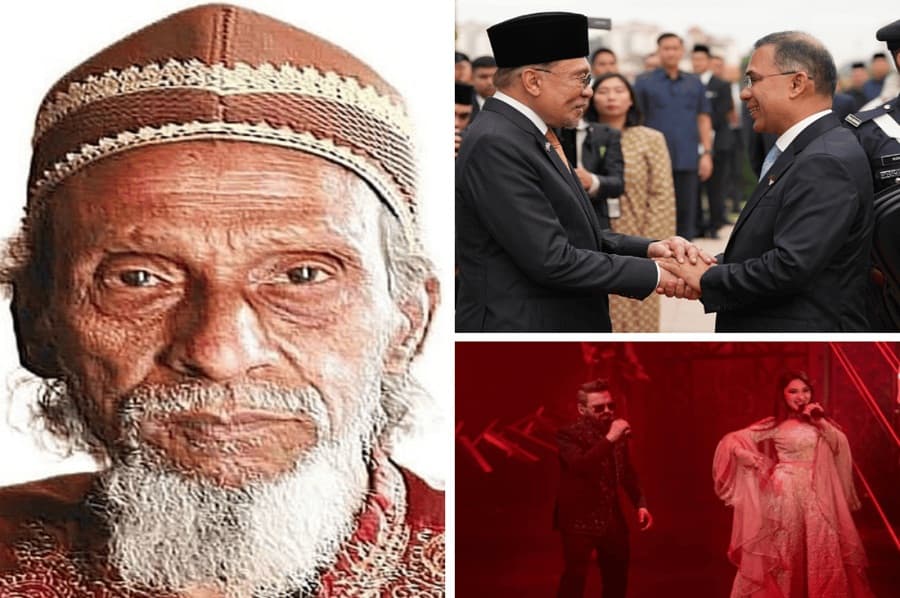
Malaysian PM Anwar Ibrahim's office put out a video in late June marking Tarique Rahman's first official visit to Kuala Lumpur as Bangladesh's prime minister. Two minutes forty seconds. Bilateral talks, a state lunch, the usual cultural-exchange footage. Then people noticed the music running behind it, 'Moha Jadu,' sung by Habib Wahid and the Tajik singer Mehrnigori Rustam, still playing.
A million views within hours. Nobody in Dhaka expected a baul song from Sylhet to end up scoring a diplomatic press video. That 'mismatch' is basically why it went viral.
The song wasn't new to fame, exactly. It had its moment on Coke Studio Bangla's third season, where Bengali lyrics ran alongside Persian verse, the Farsi half written by Hadis Dehghan, and the line 'Amar bondhu moha jadu jaane,' my friend knows a great magic, became one of those phrases people quote without remembering where it's from.
What most listeners didn't know, and still don't, is that the man who wrote those words spent something like ninety years in one Sylheti village and never once tried to be known for it. His name was Khoyaj Mia.
He was born on March 12, 1942, in Doulatpur, under Bishwanath upazila, to a moulvi named Azizur Rahman and his wife Achtura Bibi.
Music wasn't allowed in their house, fairly standard for a moulvi's household at the time. Still, Khoyaj wanted the flute more than he wanted his schoolbooks.
His formal education didn't survive past the third grade. He kept slipping off to gaaner ashor in other villages, hiding it from his father for as long as he could get away with it.
1962 is the year everything turns. At 22, he left home without telling anyone and set out to find a guru.
Found one in Fakir Durbin Shah, known as 'Gyaner Shagor,' they called him, the ocean of knowledge, and took formal discipleship under him.
On the same day, he also took bayat (followership) under a second fakir, Chhabal Shah.
Up to that point, his singing had mostly been competitive, maljora gaan, the duel-style singing matches that were a real fixture of rural Sylhet. After, something in the writing shifted toward self-inquiry and a kind of humanism that sat underneath the religious vocabulary without ever quite announcing itself as religious.
A lot of what he wrote traces back to dehotattva the the idea that the body is a small working model of the universe and that whatever liberation looks like, you find it through the body rather than beyond it. He'd write about longing in language that's almost uncomfortably physical and somehow still entirely about God; one line of his goes roughly: "In love's fire, let body and soul be burned; let the tears of two eyes soak the cloth at the chest." The Sufi line of thought is unmistakable, but his songs never really carved out room for sectarian point-scoring. Religion, caste, creed, none of that mattered much in his lyrics.
He apparently wrote hundreds of songs throughout his life. Several became the titles of others' albums.
Singers like Dolly Sayontoni and Shimul Khan had recorded their work decades before Coke Studio touched 'Moha Jadu.'
In an interview with the researcher Goutam K. Shuvo, Khoyaj Mia said he'd written the song around 1968, during a period when he was, his words, doing a lot of looking inward.
For the better part of fifty years after that, it just lived the way folk songs live, passed singer to singer, sung at village gatherings, recorded here and there, never going anywhere near a wider audience.
And he didn't push for one. People who wrote about him reach for words like nibhritchari, withdrawn, deliberately so and prochar-bimukh, allergic to publicity.
Even late in life, he kept performing, kept writing, and told someone in his seventies that he wanted to sing until his last day and that he hoped someday to see all his songs collected under one cover.
Khoyaj Mia died June 26, 2025, at home in Doulatpur, after a long stretch of age-related illness. He was 83. The janaza was held the next morning at the grounds of Doulatpur Adarsha High School and College, and he was buried in the family graveyard there.
By then, he'd already seen 'Moha Jadu' become something of a hit through Coke Studio. What he didn't live to see was a Malaysian prime minister's office putting his song under footage of two heads of state shaking hands, almost exactly a year to the day after he died, a village mystic's self-searching from 1968, on loop, behind a 2026 diplomatic handshake. Folk songs travel strangely like that. Often further than anyone writing them ever expected.
mahmudnewaz939@gmail.com