


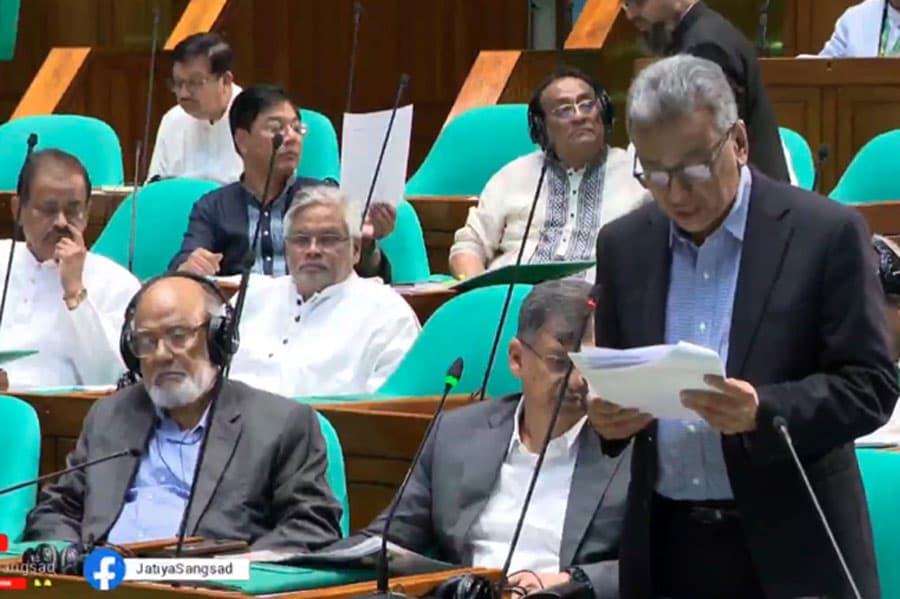
Finance Minister Amir Khosru Mahmud Chowdhury has said Bangladesh is transitioning from a debt-driven economy to an investment-led one, with private enterprise, innovation and employment set to drive future growth.
The minister made the remarks on Monday while winding up the discussion on the proposed FY2026-27 budget in the Jatiya Sangsad.
He said the current government inherited a fragile economy and weakened institutions but remains confident of restoring macroeconomic stability and achieving sustainable growth.
“No matter how great the challenges are, they can be overcome through proper leadership, effective institutions, an efficient public administration and the spontaneous participation of the people,” he said.
The government aims to build an economy where the benefits of growth are widely shared and investment, production and employment become the key engines of development, he added.
Khosru said the government is pursuing a three-pronged strategy—Recovery and Stabilisation, Restoration, and Reconstruction for Acceleration (3R)—to revive the economy.
To reduce reliance on debt, the government plans to cut bank borrowing by Tk 60 billion in the next fiscal year, list state-owned enterprises on the stock market and expand alternative financing through bonds and equity instruments.
The minister said the government has intensified its crackdown on financial crimes. As of May 2026, assets worth around Tk 723.43 billion had been seized or frozen at home and abroad, while 23 Mutual Legal Assistance requests had been sent to 13 countries to recover laundered assets.
Referring to the proposed budget targets of 7.5 per cent inflation and 6.5 per cent GDP growth, he said policy reforms, stronger performances in agriculture, industry and services, and continued growth in exports and remittance inflows would support the recovery.
On revenue mobilisation, he said the government would broaden the tax base rather than raise tax rates, alongside automating tax administration and strengthening measures against tax evasion. Traditional markets and small grocery shops will remain outside the proposed flat-rate VAT regime.
Reassuring depositors of the five merged Shariah-based banks, Khosru said protecting public deposits remains the government’s top priority. Individual depositors will be allowed to withdraw up to Tk 200,000 immediately, with the remaining balances to be repaid in phases.
To deepen the capital market, the proposed budget includes tax incentives such as exemptions on income from zero-coupon bonds, lower tax rates for listed companies and enhanced tax benefits for mutual funds.
On the IMF, the minister said Bangladesh had exited the previous programme because some of its conditions were not aligned with national interests, but remained open to negotiating a new arrangement that better serves the country’s priorities.
He also outlined plans to strengthen energy security by expanding LNG import capacity, accelerating domestic gas exploration, establishing the Second Eastern Refinery and increasing the share of renewable energy to 20 per cent of electricity generation by 2030.
“The success of this budget will depend not on its announcement, but on its effective implementation,” the finance minister said.
newsmanjasi@gmail.com