


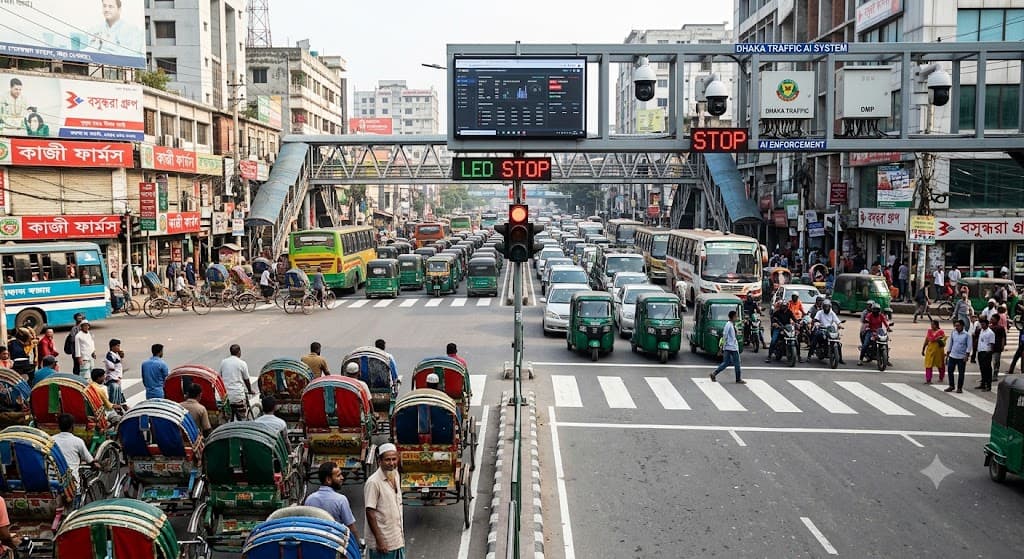
If you go past the intersection of Karwan Bazar, infamous for traffic on a rickshaw, you will see that traffic has momentarily stalled. But instead of the usual chorus of unnecessary honking and race, the vehicles stand still; a scene that was unimaginable even a year ago in Dhaka?
Vehicles were miraculously waiting behind the white stop line. A neighbouring rickshaw puller grinned and said, "You won't get away with it now, AI detects everything.
For decades, Dhaka's roads felt like participating in an unregulated extreme sport. But as the rickshaw puller astutely noted, that time of human negotiation at the traffic signal is coming to an end.
The Dhaka Metropolitan Police (DMP) has officially handed the baton of traffic enforcement to Artificial Intelligence, fundamentally transforming the daily commute for millions.
The inevitable shift to digital enforcement
To understand why AI integration was necessary, one must look at Dhaka's historical struggle with traffic management.
The city saw its first traffic signals installed in the 1960s. This was followed by heavily funded World Bank projects from 1999 to 2019 and JICA-backed initiatives up to 2018. Millions of dollars were spent, but all of these systems ultimately failed to bring lasting discipline.
The core issue was never the lights themselves. It was the lack of consistent, automated enforcement.
When a traffic sergeant spotted a violator, they had to physically step into moving traffic, pull the vehicle over, and write a paper slip or use a POS machine. This process is outdated.
The manual system was highly susceptible to human bias. A driver might talk their way out of a ticket, drop the name of an influential relative, or negotiate. This created a culture of impunity which the AI have eliminated.
The camera has no mind, no feelings, and no mercy. It does not care about the driver's social status, the model of their car, or who their uncle is. It only recognises the rules and the vehicle's number plate. This shift from manual to digital was the viable path to restoring order.
Where are these digital sentinels?
The hardware powering this system relies on advanced PTZ (Pan-Tilt-Zoom) cameras. These are not your average CCTVs. They can rotate 360 degrees, utilise powerful optical zoom to clearly capture number plates from long distances, and track moving vehicles with incredible precision.
Currently, these digital sentinels are installed at critical chokepoints across the capital. You will find them actively monitoring intersections like Hotel InterContinental, Pan Pacific Sonargaon, Banglamotor, BijoySarani, Jahangir Gate, and Karwan Bazar.
How the AI trap works
The system is programmed to instantly identify specific violations without human intervention.
Red light tracks vehicles moving through the intersection after the signal turns red and the designated ensures pedestrian crossings remain clear. The AI detects vehicles moving against the designated directional flow, a common and dangerous practice among motorcycles and VIP vehicles and identifies vehicles blocking the left-turning lane or making illegal, sudden lane changes that cause massive tailbacks.
It flags vehicles that remain stopped in unauthorised zones for extended periods, reducing congestion caused by random drop-offs.
When a violation occurs, the software captures a short video clip and extracts the number plate using Optical Character Recognition (OCR).
It instantly cross-references this data with the Bangladesh Road Transport Authority (BRTA) server, and an electronic case is automatically generated.
The vehicle's registered owner receives a prosecution notice via SMS within hours. This message includes a link to view the video evidence of their exact offence. There is no room for denial.
The human cost of manual policing
We often forget the human cost of the old system. For years, traffic sergeants stood under the sun, amidst toxic fumes, and in the pouring monsoon rain. The physical and mental toll on these officers was immense. In just the first few weeks of its launch, the system automatically logged thousands of cases. This volume would require immense manual labour to achieve.
Traffic sergeants are no longer forced to act as physical barricades. Instead, they can focus on broader traffic management, emergency response, and assisting citizens.
A win for the masses
The integration of AI is proving to be a rare instance in which both the general public and governing authorities are seeing immediate, tangible benefits.
The most noticeable advantage is the drastic reduction in wait times at intersections.
The economic toll of Dhaka's traffic jams is staggering, costing the nation billions annually in lost hours and wasted fuel. Smoother intersections mean a gradual reduction in these massive economic losses.
Pedestrians can finally use zebra crossings safely. Cars now reliably halt behind the stop lines out of fear of automated fines.
The government's roadmap for tomorrow
The immediate success of the AI traffic system has catalysed the government's ambitions to rapidly scale the technology. The roadmap for the future of traffic management in Bangladesh is aggressive.
The government plans to deploy these AI-based signals at more than 100 key intersections across Dhaka in the immediate phase. The long-term goal is to cover hundreds of strategic locations across the capital and eventually expand to Chattogram and Sylhet.
The most severe upcoming deterrent is the integration of a penalty point system. Under BRTA rules, driving licenses will carry points.
Each automated fine will deduct points from the vehicle owner's license. Once the points are exhausted, the license will be suspended or permanently cancelled.
Ultimately, the greatest achievement of the AI integration isn't just technological. It is psychological. The simple fear of an invisible, uncompromising digital system has instilled a culture of compliance that decades of fines and manual policing could never achieve.
People are finally learning to respect traffic laws, fearing that they will be caught out of absolute certainty.
The next time you feel the urge to cross the white line or speed through a yellow light, remember the rickshaw puller's warning. The cameras are watching, and for once, that is actually a good thing for Dhaka.
prokash811@gmail.com