


Development partners, rights groups and civil society organisations on Monday called for aligning compulsory education with the minimum employment age of 14 by extending free and compulsory education up to Class VIII to accelerate efforts to eliminate child labour.
They also stressed the need for fair wages for workers, saying low wages often force families to send their children to work, including in hazardous occupations, to support their livelihoods.
Other recommendations included effective implementation of laws and policies related to child labour, stronger coordination among the ministries of education, social welfare and labour, and closer collaboration between the government, civil society organisations and other relevant stakeholders.
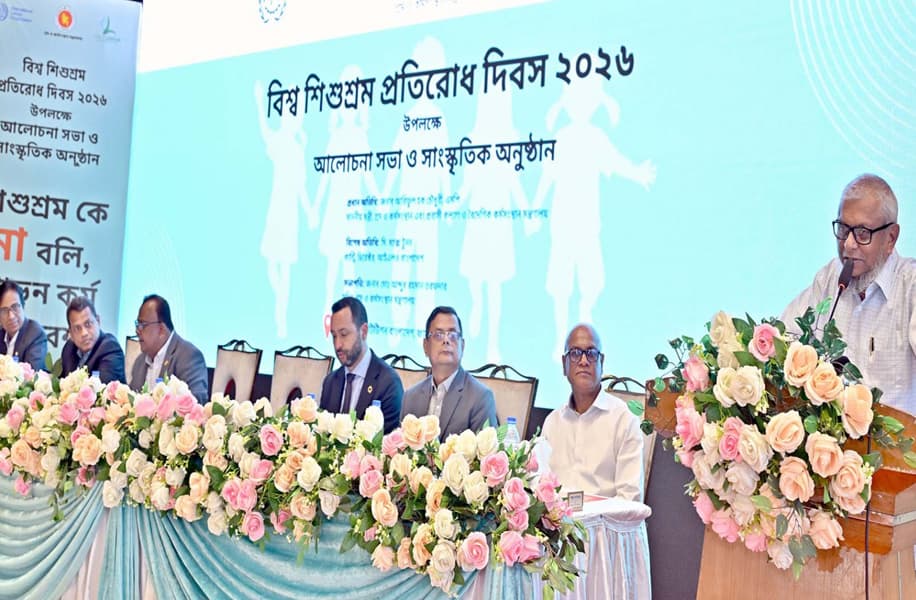
The observations and recommendations were made at a programme marking the World Day Against Child Labour 2026, held at the Krishibid Institution Bangladesh (KIB) in the capital on Monday.
Held under the global theme, "Red Card to Child Labour: Fair Play for Children, Decent Work for Adults," the Ministry of Labour and Employment (MoLE), the Child Labour Elimination Platform (CLEP) and the International Labour Organization (ILO) jointly organised discussion sessions and a cultural programme.
Speaking at the event, Labour Minister Ariful Haque Choudhury said child labour should be eliminated through practical and sustainable initiatives rather than seminars alone. He also stressed that the fight against child labour should begin at home.
He called on local and international organisations working in the sector to identify the areas most vulnerable to child labour and coordinate their efforts accordingly.
ILO Bangladesh Country Director Max Tunon said, "In line with ILO Convention 138, keeping children in school remains one of the most effective ways to prevent child labour."
Emphasising the need for stronger links between child labour programmes and social protection for vulnerable families, he said social safety net programmes that support parents while ensuring children remain in school can help break the cycle of intergenerational poverty.
He added that stronger labour inspection, timely prosecution and effective enforcement of laws and policies are also essential to deter child labour and ensure compliance with the law.
Presenting the keynote paper, AKM Ashraf Uddin, Executive Director of the Bangladesh Labour Foundation, identified inadequate budget allocations and programmes for child labour elimination, the absence of a dedicated coordinating and monitoring authority, and poor inter-ministerial coordination due to the lack of focal points in ministries as major challenges.
He emphasised the need for data-driven planning, evidence-based interventions, effective enforcement of existing laws and policies, and adequate social protection to eradicate child labour from all sectors.
Chaired by Labour Secretary Md Abdur Rahman Tarafder, the programme was also addressed by Syed Sultan Uddin Ahmed of the Bangladesh Institute of Labour Studies, Samajtantrik Sramik Front President Razequzzaman Ratan, and Munira Sultana, Child Labour and Safe Work for Youth Specialist at ILO Bangladesh, among others.
munni_fe@yahoo.com