




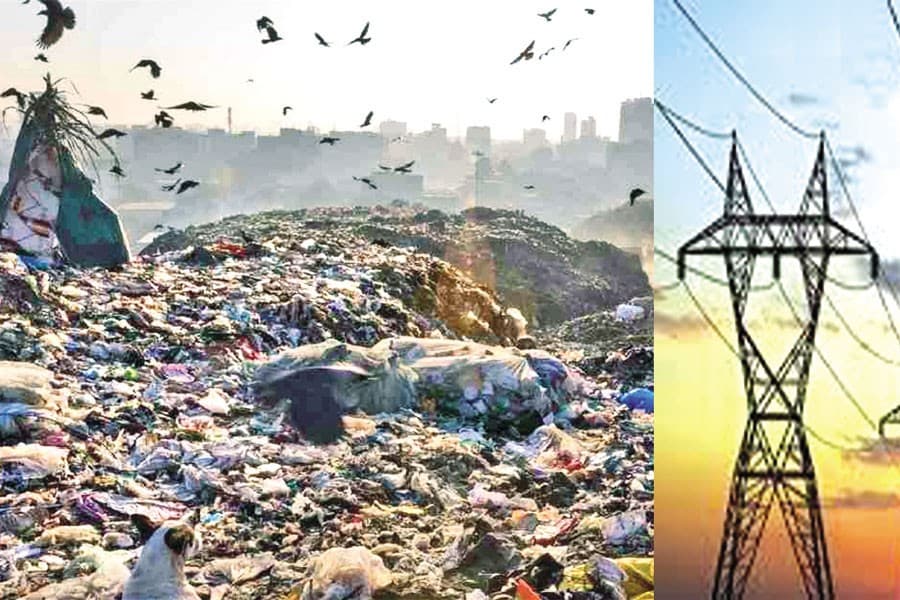
Leading environmental organisations have urged the government to immediately cancel the proposed North Dhaka 42.5 MW Waste-to-Energy (WtE) Project, describing it as one of the most expensive and environmentally damaging power projects in Bangladesh's history.
Speaking at a press conference at a city hotel on Saturday, the Coastal Livelihood and Environmental Action Network (CLEAN), Bangladesh Working Group on Ecology and Development (BWGED) and Bangladesh Environmental Lawyers Association (BELA) said the project would impose long-term economic, environmental, public health and climate costs while generating only 42.5 MW of electricity.
The organisations said the project, approved in 2020 under the now-defunct Special Act without competitive bidding, would cost Tk 57.45 billion.
Although an agreement was signed in 2021 among the Power Division, Dhaka North City Corporation (DNCC) and China Machinery Engineering Corporation (CMEC), construction has yet to begin more than four years later, they added.
The project has already acquired 30 acres of land, including 10 acres from local landowners, many of whom opposed the acquisition and have yet to receive adequate compensation. The activists said the livelihoods of around 2,000 waste pickers would be affected, while only 40 have been included in the rehabilitation plan.
At an 85 per cent plant factor, the facility would generate only 316.5 million kilowatt-hours (kWh) of electricity annually. The government would be obliged to purchase electricity at US¢21.78 per kWh, around 2.5 times the tariff for utility-scale solar power.
They claimed that if electricity generation falls below the projected level, the effective tariff could rise to Tk 47-75 per unit, while the government would still have to pay Tk 7.24 billion annually in capacity charges.
CLEAN Chief Executive Hasan Mehedi said the same investment could finance a 425 MW solar power project capable of generating nearly 688 million units of clean electricity without fuel consumption or harmful emissions.
He also said the project's per-megawatt cost of Tk 1.35 billion is nearly 2.5 times higher than that of the Rooppur Nuclear Power Plant, raising questions about its financial viability.
According to the speakers, the Asian Infrastructure Investment Bank (AIIB) and the New Development Bank (NDB) are each providing US$100 million in loans, while CMEC is investing US$157 million. However, the source of the remaining US$110 million has not been disclosed, raising concerns over transparency.
Under the project agreement, DNCC is required to supply 3,000 tonnes of municipal waste daily. With the city currently generating about 2,750 tonnes a day, the speakers said the city corporation could face financial penalties unless waste generation increases, a provision they argued discourages recycling and undermines circular economy practices.
They also claimed that, at full capacity, the incinerator would emit 73,576 tonnes of ash and particulates, 39.56 tonnes of toxic substances and 1.17 tonnes of harmful gases annually. Experts, they said, have warned that such emissions could increase the risks of cancer, cardiovascular disease and respiratory illnesses.
In addition, the plant is expected to emit 411,392 tonnes of carbon dioxide (CO₂) annually, nearly double the emissions from a coal-fired power plant of comparable output, they added.
BELA Policy Coordinator Barish Hasan Chowdhury urged the AIIB and NDB to withdraw their financing, alleging that the project violates environmental and social safeguards, including requirements for adequate public consultation.
Hasan Mehedi and Rayan Hasan of the NGO Forum on ADB criticised what they described as concessions made to accommodate CMEC's technical limitations, saying these were contrary to the public interest.
The organisations demanded the immediate cancellation of the project, fair compensation for affected landowners, proper rehabilitation of waste pickers, and greater investment in waste segregation, recycling, composting and renewable energy.
They said the North Dhaka WtE project would not only be an expensive power venture but also pose long-term risks to Bangladesh's economy, environment and public health.
azizjst@yahoo.com