




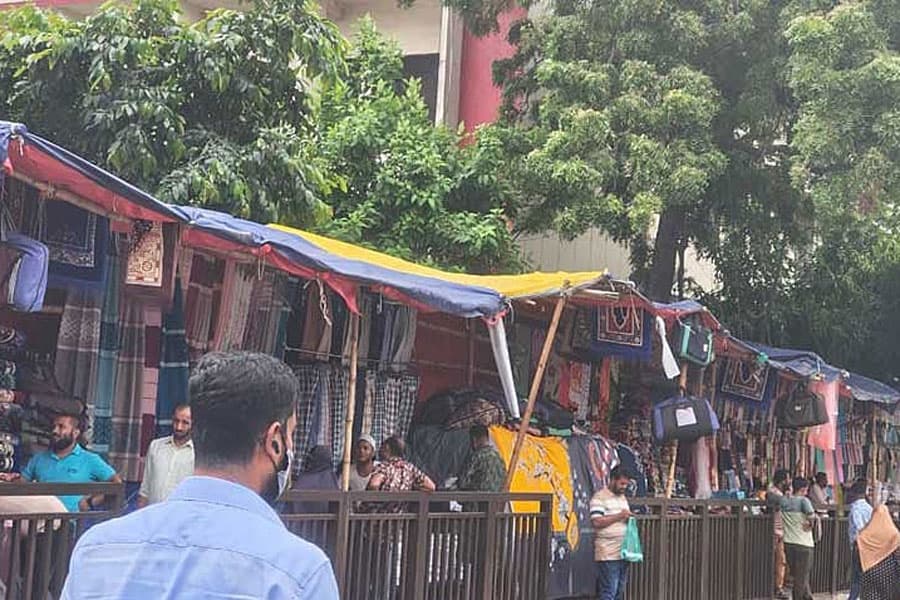
The government's promise to reclaim Dhaka's footpaths is already beginning to unravel.
Weeks after unveiling an ambitious strategy to replace repeated eviction drives with registration, rehabilitation and designated markets, hawkers have reclaimed many of the capital's busiest pavements, while several of the spaces allocated for them remain largely unused.
Along Erashad Road beside Baitul Mokarram National Mosque, where the Dhaka South City Corporation (DSCC) designated space for hawkers, buses now occupy much of the area.
Elsewhere, homeless people have settled in makeshift shelters and piles of rubbish have accumulated.
Just metres away, however, hawkers have returned to the surrounding footpaths.
In some places, temporary sheds cover entire stretches of pavement; elsewhere, rows of vendors leave pedestrians with little choice but to walk on the road.
The same scene has emerged on Abrar Fahad Avenue, formerly Bangabandhu Avenue.
Although authorities marked a vending zone near the Awami League's former central office, the designated boundaries are no longer being observed.
A visit to Gulistan on Monday afternoon found little resemblance between the government's blueprint and reality.
Similar scenes are unfolding in New Market, Farmgate and Mirpur, where hundreds of stalls set up on cots, vans and plastic sheets have once again occupied public walkways.
A New Approach, Familiar Outcome
Soon after taking office in February, the BNP-led government pledged to move away from the decades-old cycle of eviction and reoccupation.
Instead of removing hawkers by force, it promised rehabilitation, registration and a comprehensive management policy.
On Apr 25, Prime Minister Tarique Rahman instructed authorities to swiftly rehabilitate evicted hawkers and issue them QR-coded identity cards through registration.
The proposed "Dhaka City Hawker Management Policy" sets fixed locations and operating hours, prioritises internal roads over main roads, and requires clear pedestrian space of 5-8ft.
Hawker zones are to remain 30-40ft away from metro stations, bus stops and major intersections, while day-time vending in crowded areas is prohibited.
Under the plan, evening markets would operate from 6pm to 10pm in Mirpur, Gulistan, New Market, Sadarghat and Baitul Mokarram, while holiday markets could run on Fridays, Saturdays and public holidays.
Each family would be limited to one licence.
In the first phase, 302 hawkers received QR-coded identity cards. By Jun 29, authorities had registered 888 hawkers under DSCC and another 204 under Dhaka North City Corporation (DNCC).
Yet hawker leaders say earnings have fallen sharply at designated sites.
Bangladesh Hawkers Union President Abdul Hashim Kabir also alleged irregularities in the verification process.
Before Eid, DSCC Administrator Md Abdus Salam acknowledged that police had prepared the list of beneficiaries, saying it was impossible to satisfy everyone.
Eviction drives were relaxed ahead of Eid following appeals from hawkers and shortages of designated space.
Although operations continued elsewhere in the city, vendors gradually returned to areas covered by the new initiative.
Officials Remain Optimistic
City authorities insist the programme is only temporarily paused.
Abdus Salam said fresh operations would resume within days, stressing that the government wanted to establish an orderly system rather than pursue repeated evictions.
DNCC Administrator Shafiqul Islam Khan said discussions with hawkers had resumed after Eid and the programme would move forward once the budget process was completed.
Officials also said evening and holiday markets remain under consideration.
Breaking the Cycle
The struggle over Dhaka's footpaths has continued for nearly five decades, with successive governments launching crackdowns only to see vendors return within days or even hours.
Urban planners argue that history is repeating itself.
Jahangirnagar University Prof Akter Mahmud said pedestrians' rights must come first, warning that allowing one vendor inevitably attracts many more.
Institute of Planning and Development Executive Director Adil Mohammed Khan believes the government sent the wrong signal by allowing hawkers to remain while promising rehabilitation.
"Hawkers have realised this government won't remove them either," he said. "The syndicates collecting monthly extortion from them have received exactly the same message."
He argued that those controlling the system include politically connected groups and even elements within law enforcement, meaning no policy will succeed unless those extortion networks are dismantled alongside broader efforts to create formal employment and strengthen social safety programmes.