

There was a time when a village fair meant a different kind of excitement. Before evening, people from distant villages would come to the fairgrounds on foot, by bicycle, or by van.
Children carried colourful flutes, some held paper kites, while others walked through the crowd, tightly holding their father's hand.
As soon as people entered the fair, the atmosphere felt alive. Loud voices came from microphones. The Ferris wheel made a constant creaking and spinning sound. Everywhere there was movement, noise, and colour. The smell of fried snacks, sweets, and jilapi filled the air. For many people, this was one of the happiest times of the year.
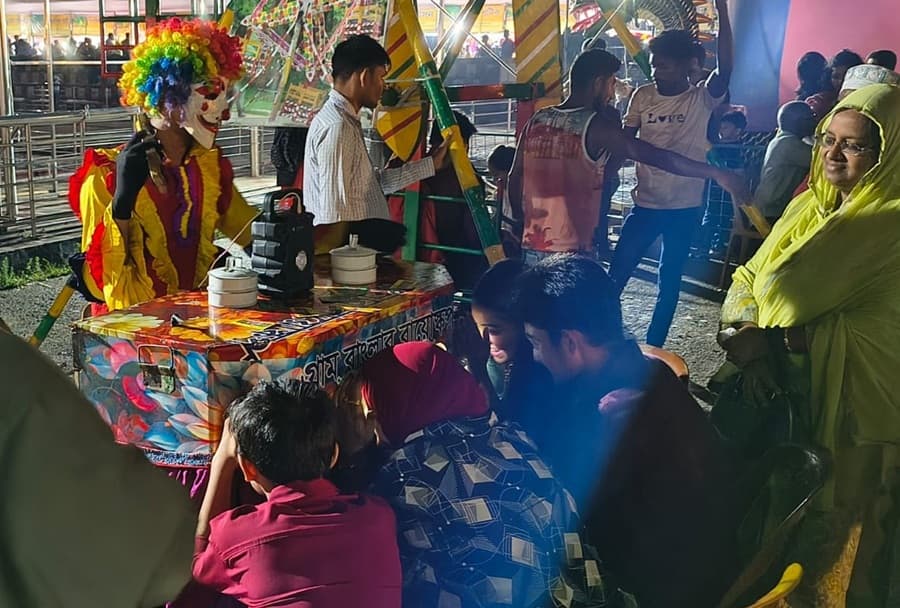
In one corner of the fair, people gathered around a wooden box.
The box had bright pictures painted on it. Some showed film stars, some showed the Taj Mahal, and some showed trains or faraway cities. Children waited in line to look inside. They looked into small holes and watched the pictures.
Next to the box stands a man who runs the show. Standing beside the box, the bioscope man described the scenes in an excited voice, turning the moving pictures into stories for the audience. This was called the bioscope.
In the past, it was a popular form of entertainment in villages. For many children, the bioscope offered their first glimpse of a world beyond their village. Through the small box, they saw cities, buildings, and stories they had never seen before. But times have changed.
The appearance of fairs has changed. Children no longer need a wooden box to see the world. Most of them have mobile phones. They can watch videos, cartoons, and movies anytime. Because of this, the bioscope is slowly disappearing.
Still, in some fairs, bioscope performers can be seen.
One such man, Md. Kaiyum has been working with the bioscope for about 22 years. He does not have a permanent shop or a fixed workplace. He moves wherever fairs are held. Sometimes it is a village fair, sometimes a town festival, sometimes a religious gathering. Wherever there is a fair, he goes there.
He shared that there was a time when he did not need to call people. Children would come running on their own. As soon as one child finished watching, another would take their place. Many children even watched the same scenes again and again because they enjoyed them so much.
Now things are very different.
People no longer gather around the bioscope in the same way. Some people stop for a short time out of curiosity, look inside for a minute or two, and then walk away. According to him, the way people enjoy entertainment has changed. Even so, he has not left this work.
Because this profession is deeply connected to his life, he has spent many years travelling from fair to fair, calling on people and showing them the bioscope.
But as times changed, he had to adjust as well. Md. Kaiyum said that earlier, he would take the bioscope to almost every fair. Back then, there were more viewers and better earnings. But now it is very difficult to depend only on the bioscope for income. People do not stop like before, and children's interest has also decreased.
Because of this change, his income has become uncertain as well. On good days, he can earn around five thousand taka, especially during big fairs. But on other days, he earns much less.
To support his family, he has also joined a puppet show group. Now, at many fairs, he performs puppet shows rather than just bioscope shows.
While he was talking, a few children came closer to the bioscope. They looked at the old wooden box with curiosity. One child bent down to look inside. Another stood nearby and smiled, waiting for his turn. The scene felt simple but meaningful.
At that moment, a song played from a nearby speaker, "Tomar Bari Ronger Melay" by the late Sanjeeb Chowdhury.
This small moment showed how much things have changed.
In earlier times, the voice of the bioscope man was enough to gather a crowd. He would call people loudly and dramatically describe the scenes inside. His voice itself was part of the attraction.
Now that has changed, too.
Loudspeakers and recorded music have replaced the human voice. Today, music and sound systems aim to attract people to various attractions at the fair. The old style of calling people is slowly disappearing.
In the past, the bioscope was an important part of rural entertainment. It gave children their first experience of the outside world. It showed them places they had only heard about. For many, it was something magical.
But today, the situation is very different.
Mobile phones and the internet have taken their place. Even at fairs, people are busy recording videos, going live on social media, or scrolling through their screens. In the middle of all this, a man standing with a wooden box feels like someone from another time.
Still, they remain.
Even if the crowds are smaller now and the attention has shifted elsewhere, the bioscope has not completely disappeared. In some fairs, when evening falls, a small crowd still gathers around it.
As the night gets deeper, the fair slowly becomes quiet. Shops begin to close. The lights start to dim. The noise slowly fades away. Then the bioscope man carefully packs his things and lifts the wooden box onto his shoulder. Tomorrow, he may leave for another fair.
Once again, he will call out to the crowd and wait for a few curious eyes to look inside the wooden box and discover a small moment of wonder.
sumaiyariva1120@gmail.com