


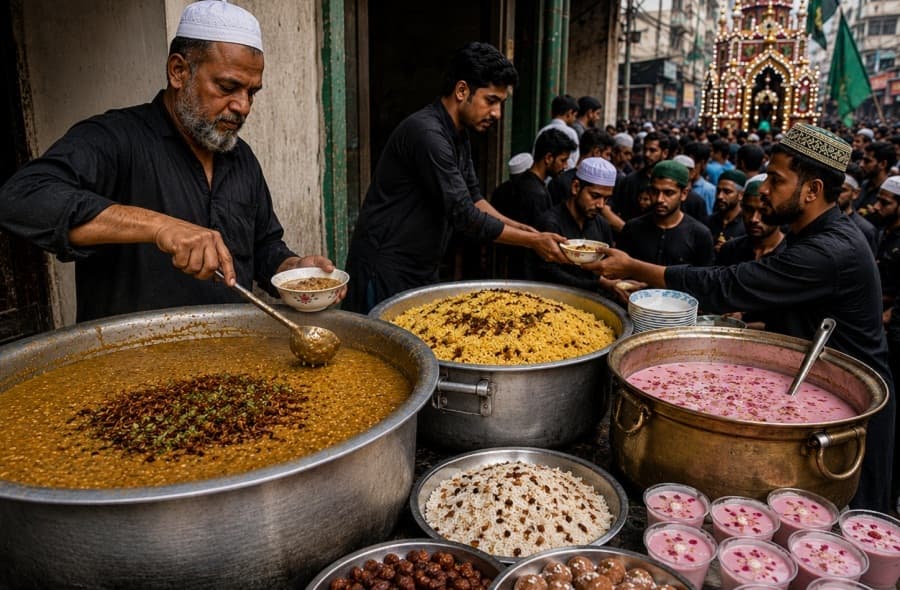
The smell reaches you first. Near Hossaini Dalan, in a kitchen with the shutters half down, a pot of haleem has been simmering on a low flame since before dawn, and by mid-morning the whole lane smells of cracked wheat, beef fat, and ghee. You would expect a month of mourning to smell of something else. It doesn't. Muharram in Old Dhaka runs, in a fairly literal sense, on what gets cooked.
Almost every household in the old Dhaka seems to be making the same dish. Haleem traces back to harras, a wheat-and-meat porridge documented in Baghdadi cookbooks a thousand years ago, which made its way into the subcontinent through Persian and Mughal kitchens well before anyone tied it to Karbala. Nobody really agrees on how that link happened.
One version has it that a surviving member of Hussain's family cooked the dish from whatever rations were left after the massacre. Another version doesn't bother with origins at all and calls it tradition, full stop, which is probably closer to the truth.
Cooking is hard work, regardless of which story you believe.
Wheat, lentils and meat get boiled separately, then combined and beaten for hours with a heavy wooden spoon until there's no texture left, just a thick, almost shiny paste.
Fried onions go on top. Then ginger, green chilli, and a squeeze of lemon. Most people eat it with a spoon, though plenty of Old Dhaka households bring out naan anyway, recipe be damned.
Very little of this haleem stays where it was cooked. Over the ten days of Muharram, it becomes niaz, food made specifically to be given away.
The word itself comes from the Persian and Urdu for an offering or a vow, and in Old Dhaka, it has settled into local usage as niaz.
However, plenty of people pronounce and even spell it newaz, the two versions sitting side by side in the same neighbourhood without anyone treating it as a problem.
Niaz or Newaz isn't really charity in the usual sense, since it's not aimed specifically at people with low incomes, and it isn't quite a gift either, since nobody expects thanks for it. It sits somewhere in between: food cooked as a kind of vow or offering, dedicated to Hussain and his household before it's handed to anyone at all, so that the act of cooking itself becomes a small religious gesture rather than just meal preparation.
Pots get sent round to neighbours, ladled out to mourners along the tazia route, served from inside the imambara to whoever happens to be hungry that hour.
Caterers around Bakshibazar and Nazimuddin Road do their busiest trade of the year in this stretch, cooking in cauldrons over open wood fires for households that don't have the time, or frankly, the patience to stand over a pot all night.
Whoever eats the haleem usually doesn't pay for it and probably didn't cook it either. That habit, more than anything else in the recipe, is what makes this Muharram's dish, not a regular Old Dhaka's haleem.
Not everything handed out during Muharram is haleem. In some imambaras, visitors leave with a small packet of tabarruk, a spoonful of sweet rice, a few dates, sometimes just a simple sweet wrapped in paper.
The contents change from one place to another. Around Hossaini Dalan, people tend to talk about the haleem and sherbet. Elsewhere, an imambara might be known for its khichuri, its zarda, or a particular family recipe that appears every Muharram and then disappears again for the rest of the year.
Sherbet is the other fixed point of the month, though the Muharram version is quieter than what Old Dhaka sells every day.
The everyday stuff, Lalbagh's badam sherbet, the lemon and lassi at Chawkbazar's Noorani, the thick cardamom glasses going for fifteen taka near Rai Saheb Bazaar, belongs to a louder, more commercial world, sold cold off carts to whoever's passing.
Doodh ka sherbet or Mohabbat ka sharbat isn't entirely different. Milk is slowly simmered with ground almonds and pistachios, sweetened and scented with cardamom, and served at room temperature or barely chilled, never on ice.
A few families still finish it with a touch of oudh, agarwood smoke stirred in right before serving. However, that habit is dying out faster than the older generation would like.
It's a drink made for people who've come to grieve, and somehow it never tastes festive, even when it's sitting on a table that otherwise looks like a celebration.
The rest of the table fills out with food that sits somewhere between mourning and minor festivity without much trouble.
Zarda, the saffron-coloured sweet rice with nuts and raisins folded through it; kheer, made slow with reduced milk; khichdi (Khichuri), a heavier, grainier relative of haleem cooked with seven kinds of grain instead of just wheat.
Easy to miss among all that is a plain rice and black lentil dish, made deliberately without the onion and spice everyone usually reaches for, which some households cook specifically on Ashura to mark the day Hussain and his companions went without food and water at Karbala.
The rest of the month feeds people generously, almost recklessly. This one dish goes without, on purpose, because that's the point.
In some homes, especially after majlis, trays of shirni make their way around the room alongside sherbet. It might be sweets, fruit, or a little sweet rice, depending on the household. Nobody seems to make much fuss about it. Someone carries the tray over, takes a round of the room, and before long, it's gone.
By the time the tazia reaches, most kitchens in Old Dhaka have already emptied themselves into the street. Pots stacked by the doorway, a smear of haleem still on the ladle, somebody's child carrying a covered dish three doors down because their mother told them to, which is niaz doing its quiet work without anyone calling it that out loud.
Whatever any one dish is supposed to mean theologically, on the ground it comes down to something much plainer: a neighbourhood feeding itself and everyone within reach of it for ten days running, then cleaning up and doing it again the next year.