


The newly appointed chairperson of the Insurance Development and Regulatory Authority (IDRA), Mir Nadia Nivin, on Saturday called for a fundamental shift in mindset across the insurance industry, urging all stakeholders to move beyond identifying problems and focus on implementing structural reforms to restore public confidence.
Speaking at a dialogue titled "Vision for reforming and modernizing the Bangladesh insurance sector," organised by the Insurance Reporters Forum (IRF) in the capital, Nivin said the sector's recovery would require coordinated efforts by policymakers, regulators and industry operators.
"I hear and understand the problems, but I prefer to think from a solution point of view," she said, noting that lasting structural reform rests on three pillars: political will, regulatory will, and industry will.
"If we genuinely intend to fix this sector, we must act as partners. There is no alternative to a partnership modality," she said.
"We have political backing, and we have the regulatory will," she said, but warned that no regulatory intervention would succeed if insurance companies remained focused on short-term financial gains and quick cash extraction.
The IDRA chairperson asked insurance boardrooms to clean up their acts.
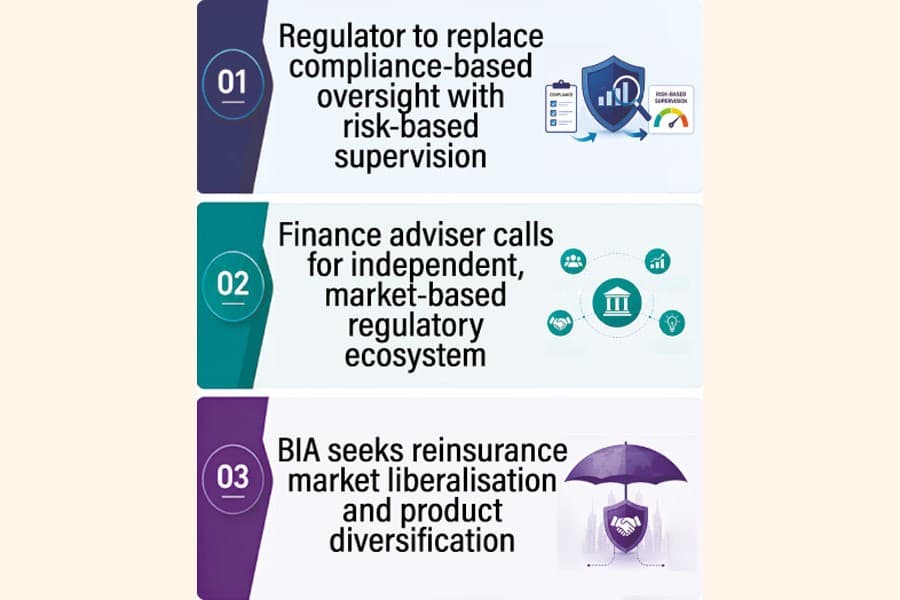
A core element of the regulator's reform plan involves dismantling the current "compliance-based supervision," Nivin said, describing it as outdated and ill-suited to modern financial oversight.
She pointed out that regulating modern firms using historical disclosures leaves the supervisor blind to real-time market shifts. "Compliance-based supervision relies on mechanisms from the 1960s. Companies submit data based on financial histories from an entire year prior. Relying on old data is meaningless when financial scenarios and market risks are changing daily," she explained.
To address this, IDRA is accelerating the deployment of a Risk-Based Supervision (RBS) framework driven by digital technologies.
According to the IDRA chief, the new system will enable regulators to monitor companies using real-time data, identify emerging risks early and intervene before insurers face financial distress.
"Regulating isn't just about wielding a stick," she said. "With precise, real-time data, we can collaborate with companies, identify dangerous operational trends early, and warn them before they drift into insolvency."
Addressing concerns over unpaid insurance claims and funds tied up in troubled banks, Nivin said the regulator would examine practical options to improve liquidity, including discussions with Bangladesh Bank on recovering insurers' deposits and assessing whether treasury bonds could be liquidated to settle policyholders' claims.
She, however, stressed that any proposal for government financial support would be conditional on meaningful governance reforms by insurance companies.
"We can consider a one-time bailout package before the government, but the industry must complete its internal homework first," she said, adding that company boards would need to provide assurances that past governance failures would not be repeated.
Speaking as the chief guest, Dr. Rashed Al Mahmud Titumir, the Prime Minister's Adviser on Finance and Planning, warned against systemic governance failures, noting the sector has historically been viewed as a mere "commission business" by political opportunists.
He identified weak investment practices and the lack of digitalisation as two major challenges facing the sector and cautioned against excessive regulation.
"Over-regulation fosters theft. The line between adequate oversight and over-regulation is very fine," he said.
Instead, he called for an independent, market-based regulatory ecosystem supported by strong third-party institutions, including professional auditors, surveyors and credit rating agencies.
The adviser also assured participants that the government would consider incorporating the dialogue's recommendations into future policy reforms.
Bangladesh Insurance Association (BIA) President Sayeed Ahmed said the industry's long-term growth would rely on modernising products, protecting policyholders' investments, and breaking market monopolies.
He strongly advocated for ending the current monopoly in the reinsurance landscape by allowing the private sector to set up competitive reinsurance companies.
Ahmed also stressed the need to diversify insurance products and reform commission-driven business practices to promote insurance as a long-term financial protection tool rather than a means of generating quick profits.
Concluding her address, Nivin pledged to pursue reforms with flexibility and determination, saying she would engage with all relevant stakeholders to modernise the sector.
She also urged insurers and the media to work collaboratively to rebuild public confidence in the insurance industry.
farhan.fardaus@gmail.com