




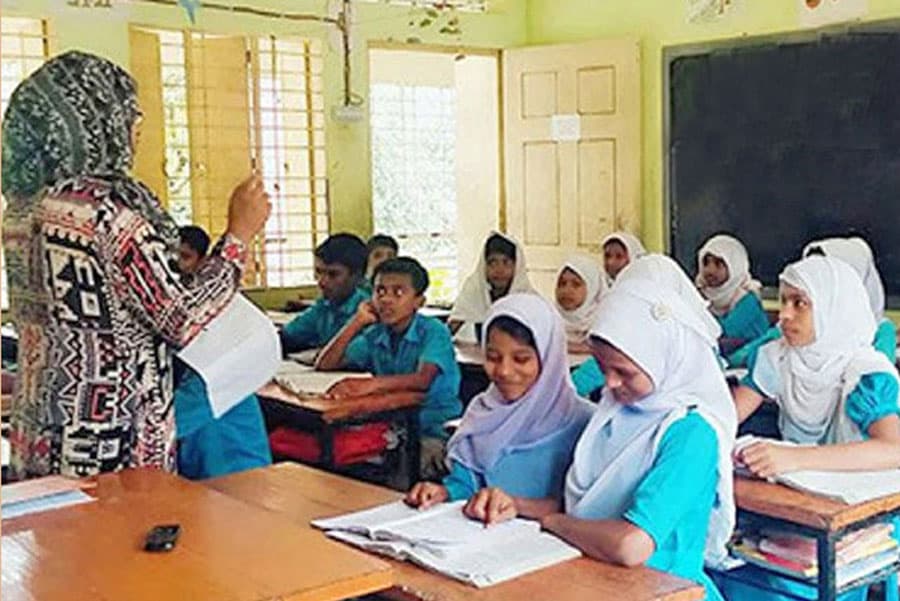
What a recent report based on the inspection titled, ‘Foundational Literacy and Numeracy of all Primary School Students in Dhaka and Narayanganj Districts’ conducted under the primary and mass education ministry showed about the basic knowledge acquired by primary schoolchildren was anything but encouraging. It cannot also be said that the report was revealing. If anything, it confirmed what the public already knew. The inspection carried out last month (June) by the Compulsory Primary Education Implementation Monitoring Unit on all the government primary schools in the Dhaka and Narayanganj districts, which number over 2,200, found that the literacy and numeracy levels of the primary students (from Grade-1 to Grade-5) was extremely poor. As for example, Grade-5 students in Dhaka and some other districts could not recognize or read all the letters of Bangla alphabet, not to speak of English alphabet or words. Regarding numeracy, for instance, Grade-2 students were found struggling to subtract one single digit number from another. The inspection report was of the view that the method of teaching basic arithmetic was to blame for the poor performance of the schoolchildren.
Also, lack of qualified teachers, poor monitoring by education authorities, inadequate school infrastructures and so on were believed to have impacted the schoolchildren’s performance. Various local educational research organisations in collaboration with international ones also found similar conditions of our government primary schools and the education imparted to the children there. In this connection, the World Bank (WB)’s 2022 Human Capital Index (HCI), which, actually, is a measure of future workforce productivity, was 51.2 per cent. Also called, ‘learning poverty rate’, the score says that more than half of the children under scrutiny won’t be able to read and understand a simple age-appropriate text by the age of 10. These study findings, if anything, are actually the products of the study/research methodologies. Essentially, they tell the same story of primary level education in our schools which are not improving with the passage of time.
The recently published report that the education minister ANM Ehsanul Hoque Milon was shocked at the fact that over 36 per cent of HSC and equivalent exam candidates ultimately dropped out from the public exams held this year also tell a similar story, though the contexts are different. The minister was especially flabbergasted by this year’s dropout rate because it far exceeded the usually recorded dropout rate of 10 per cent or less. In fact, as the official data show, close to one million and a half students who registered for Class XI two years ago did not fill out the final exam forms. However, the dropout rate varied by education boards. What does this imply? Schools are not aware of, or worse, indifferent, to the students beyond their classes. For many parents in the poverty-stricken rural, even urban and semi-urban, communities, education for their children is a luxury. There is no provision to retain those children in the classes. Teachers cannot ensure if all the students are able to comprehend the lessons taught in a class.
Teachers, in many cases, are not trained to do their job. The abnormal HSC-level dropout rate this year may have also to do with stricter examination halls, less emphasis on increasing pass rates by the authorities, etc. Also, worsening economic conditions of the lower middle class and poor households due to rising cost of living and high inflation might have forced many families to stop their children’s education. The education ministry needs to investigate the matter deeply. It can select some schools with high dropout rates of HSC candidates and involve the schools concerned in finding out what exactly dissuaded their students from appearing in the exam. The fact that the dropout figure is enormous, it must be a very complex issue and has no single or simple answer to it. Actually, the entire government-run school education system should be placed under the scanner. Most importantly, schools should be sensitive to the needs of individual students. It has to be more humane.
sfalim.ds@gmail.com