



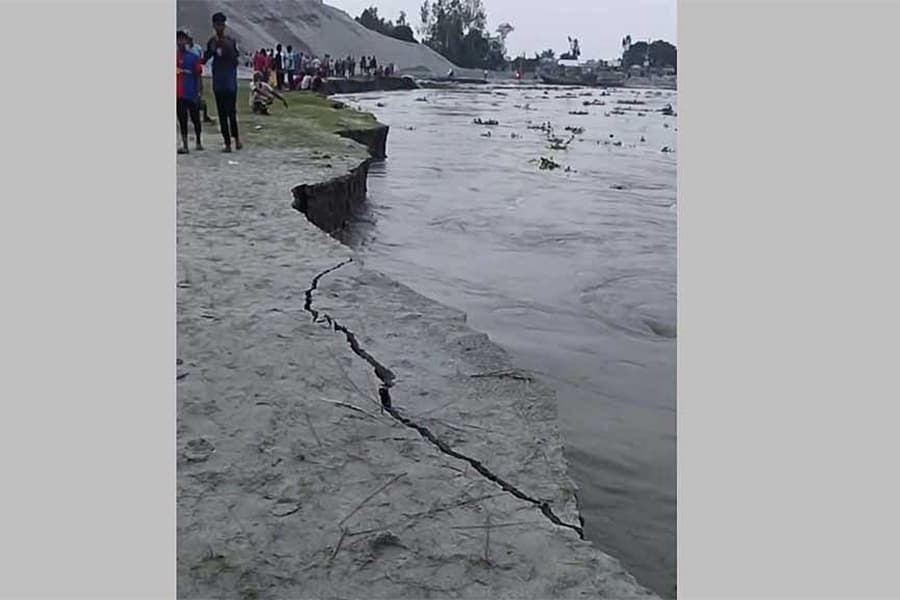
Continued erosion by the Jamuna River along its banks has thrown residents of Bogura’s Dhunot Upazila into extreme anxiety.
Erosion has become particularly severe in the area between Bhandarbari Union’s Shahrabari and Baniajan Spur, a concrete stone embankment made to protect the riverbank.
The Bogura Water Development Board (WDB) says that steady erosion for the past 12 days has caused a 200-metre area of land to disappear into the river’s waters as of Sunday. Work is under way to place sand-filled geo bags and geo tubes in the affected areas day and night to try and rein in the erosion.
Meanwhile, locals allege that the erosion has been caused by unplanned sand extraction along the riverbank.
Mahmud Hasan, executive engineer of Bogura WDB, said: “The flood control dam was at risk due to erosion in the upstream section of the Shahrabari spur.
“To deal with the situation, geo tubes and geo textile bags were immediately placed in the affected areas. As a result, the area is largely risk-free for now.”
Golam Mohammad Siraj, the Bogura-5 MP, visited the erosion-affected area on Sunday afternoon. He instructed the WDB officials to take quick, effective measures to prevent erosion.
At the same time, he assured that he would take initiatives to implement a project to permanently prevent such erosion.
Significant erosion in the area began for the first time around October 2025. A large tract of agricultural land, as well as nine shops at Shahrabari Ghat, was lost to the Jamuna.
Later, the WDB brought the erosion under control by dumping geo bags and geo tubes. But 12 days ago, the erosion started again.
The WDB says that in Bhandarbari Union, residential areas, agricultural lands, roads and other village infrastructure along the banks of the Jamuna River have disappeared due to severe erosion.
Even before that, the erosion wiped eight to 10 settlements, including Baishakhi Char, Randhanagar, Bathuarvita, New Sariakandi, Atarchar, Pukuria, Bhutabari and Koiyagari off the map.
After losing their homes, residences, and farmland to the Jamuna, thousands of destitute people have sought refuge in the area protected by the flood control dam.
The people affected by the erosion survive by fishing in the Jamuna and growing crops in the Chars that emerge during the dry season.
According to information from the WDB, it built two spurs in the Shaharabari and Baniyajan areas of the Jamuna River at a cost of about Tk 120 million.
After the construction of these bank protection structures, the river's main flow shifted away from the banks, thereby protecting the flood control dam in the area for a long time.
However, in 2021, about 50 metres in front of these structures in the Baniyajan and Shaharabari areas disappeared into the Jamuna River due to severe erosion.
At the same time, several parts of the village were also lost to the river. Since then, the two bank protection structures and the approximately 200-metre area between them have not seen any significant erosion.
However, locals say sand extraction is also playing a part. They say that a lease was issued to excavate the sand pit in the area between the two spurs for the past two years, but the lessees have been extracting sand from the area near the right bank of the Jamuna instead of from the designated location.
They claim that this extraction of sand near the riverbank has changed the natural flow of the river and increased the intensity of erosion.
An inspection of the bank protection structure shows collapses in several areas amid the strong current of the Jamuna. This damage has spiked local anxiety about local river erosion.
Bogura WDB Sub-Divisional Engineer Humayun Kabir said about a 200m area had been eroded so far.
He noted that the approximately 1,800-metre area between the Shaharabari and Baniajan bank protection structures is the most vulnerable.
He said, “Emergency protective work needs to be done in this section. Otherwise, the two bank protection structures and the flood control dam may be under threat.”
Sajedul Haque, a resident of Baniajan village, said, “In addition to the construction of two spurs in Shahrabari and Baniajan areas to prevent erosion of the Jamuna River, a flood control dam was built in 2007 under the Right Bank Conservation Project.
“But every year during the monsoon season, the dam and bank protection structures are under threat due to the erosion of the Jamuna.”
Altaf Hossain, a resident of Shimulbari village, complained, “The WDB does not take any effective preventive measures in the dry season. As soon as the monsoon starts, there is an activity of dumping sand-filled geobags or sacks.
“This is a waste of government money. Although millions of taka are spent every year, there is no permanent solution.”
Sohrab Ali, a resident of Shahrabari village, said, “The agricultural land of many farmers in the area around Shahrabari has disappeared into the riverbed due to erosion in the last few days.
“Many families are facing extreme financial crisis after losing their land. Some have almost become destitute.”
Dhunot Upazila executive officer Arif Ullah Nizami was asked about the locals' complaints that sand mining has caused severe erosion in the Shahrabari and Baniajan areas.
In response, he told reporters that several raids had been conducted against illegal sand miners in the Jamuna based on complaints from local residents along the river. The WDB is working to repair the damaged parts in the Shahrabari area, he said.