


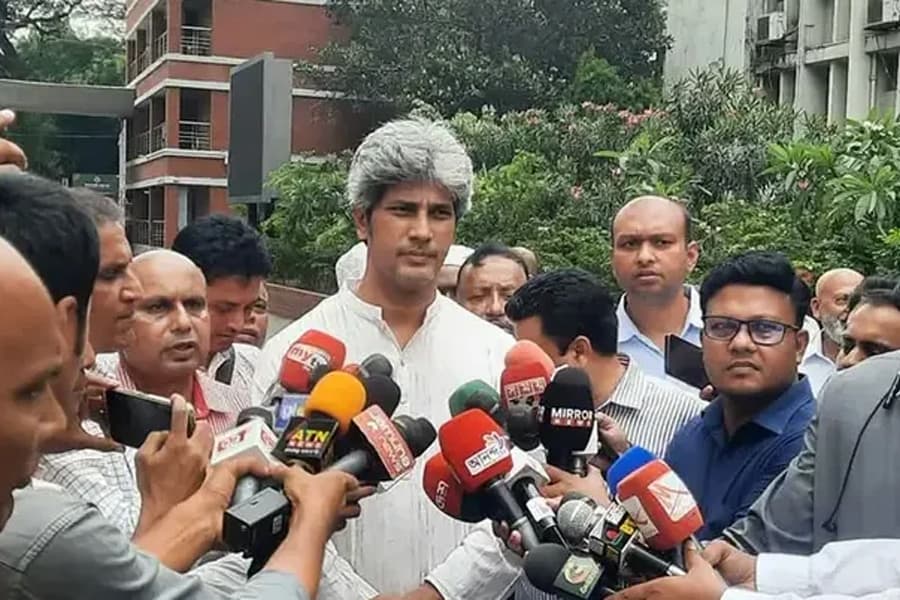
State Minister for Planning Zonayed Saki on Sunday said the World Bank-supported Strengthening Institutions for Transparency and Accountability (SITA) project would strengthen institutional capacity, improve public services and support Bangladesh's economic growth through greater transparency and accountability.
Speaking at the launch of the project at Pan Pacific Sonargaon Hotel in Dhaka, he said the initiative would help the government achieve its development goals through evidence-based decision-making, according to UNB.
The five-year project, to be implemented from 2025 to 2030, will be jointly executed by the Planning Division, Bangladesh Public Procurement Authority (BPPA), Bangladesh Bureau of Statistics (BBS), National Board of Revenue (NBR) and the Office of the Comptroller and Auditor General (OCAG).
The project will cost Tk 32.87 billion, including Tk 30.43 billion in financing from the World Bank's International Development Association (IDA) and Tk 2.44 billion from the government.
Saki said the project would automate key public service functions across the five agencies and strengthen coordination through integrated data systems.
He said it would also support timely implementation of development projects by improving project planning, monitoring and public procurement.
The state minister stressed the need to modernise tax administration, accounting and audit systems, inflation and GDP measurement, and upgrade the electronic government procurement (e-GP) platform.
Highlighting Bangladesh's fiscal challenges, he said the country's budget-to-GDP ratio stands at only 13 per cent and needs to increase significantly to meet growing expenditure needs.
World Bank Division Director for Bangladesh Jean Pesme said the project would help the country address key challenges, including sustaining economic growth, creating jobs, improving transparency and strengthening public institutions.
World Bank official Sebastian Eckardt said around 1.6 million young people enter Bangladesh's labour market every year, making job creation a major priority. Effective implementation of the project would improve public service delivery, he added.
Planning Division Secretary SM Shakil Akhtar said the project would strengthen coordination among the implementing agencies.
NBR Chairman Abdur Rahman Khan said Bangladesh's tax-to-GDP ratio, currently below seven per cent, should be raised to around 15 per cent through greater automation and stronger efforts to curb tax evasion.
BPPA Chief Executive Officer SM Moin Uddin Ahmed said the authority aims to introduce a cloud-ready e-GP Version 2.0 platform by 2030 to establish a fully digital and transparent public procurement system.
IMED Secretary Sirajun Noor Chowdhury said the government is pursuing investment-led inclusive growth while Comptroller and Auditor General Md Nurul Islam said the project would digitise accounting and audit systems to improve service delivery.
According to the World Bank, the project, approved on June 12, 2025 with financing of US$250 million, aims to modernise Bangladesh's core public institutions through reforms in public financial management, procurement, statistics, tax administration and auditing.
Among its targets are developing an integrated national data ecosystem, introducing e-invoicing in tax administration, using AI-enabled analytics for project monitoring, upgrading the e-GP system and reducing audit reporting time from 72 months to nine months.