


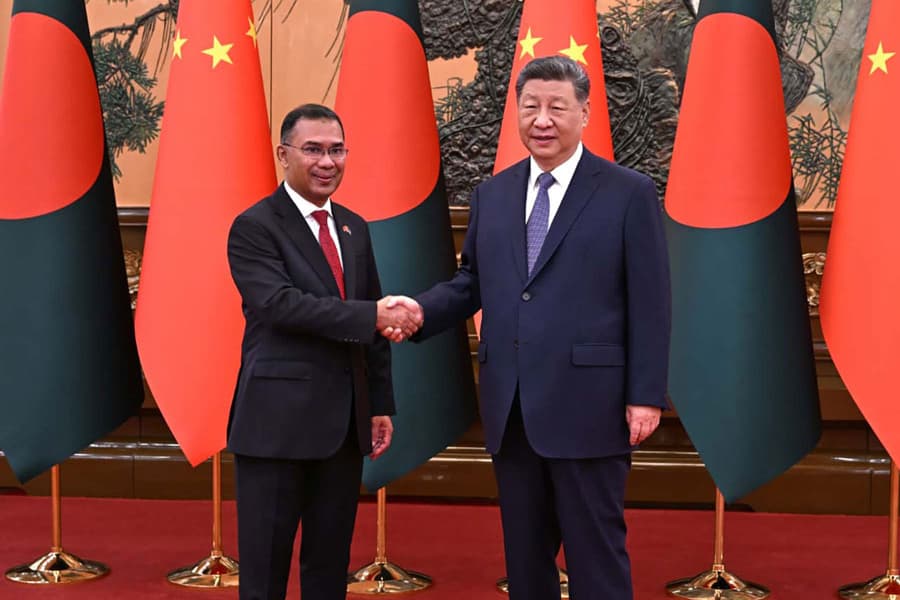
Bangladesh and China have agreed to build "China-Bangladesh community with a shared future in the new era" in a significant expansion of strategic cooperation encompassing trade, infrastructure, connectivity, water management, defence, technology and regional diplomacy.
The decision was announced following talks between Chinese President Xi Jinping and Bangladeshi Prime Minister Tarique Rahman at the Great Hall of the People in Beijing during Rahman's first official visit to China as prime minister.
 A joint communiqué issued after the meeting says the two countries agreed to upgrade their comprehensive strategic cooperative partnership and deepen cooperation across a broad range of sectors while maintaining regular high-level political dialogue.
President Xi says China attaches "great importance" to its relationship with Bangladesh and reaffirms Beijing's longstanding policy of friendship towards the country.
"No matter how the world changes, China will not waver in its commitment to the overall direction of China-Bangladesh friendly relations," the readout quotes Xi as saying, describing China as Bangladesh's "trustworthy good friend, good neighbour and good partner."
Xi has said China supports Bangladesh in safeguarding its national independence, sovereignty and territorial integrity and opposes foreign interference in the country's internal affairs. He also pledges closer cooperation in governance, development planning, digital technology, green development, healthcare, education and artificial intelligence.
Prime Minister Tarique Rahman has described China as a trusted strategic partner and welcomed the elevation of bilateral relations.
Bangladesh hopes to deepen cooperation under the Belt and Road Initiative, particularly in trade, agriculture, connectivity, technology, education, healthcare and renewable energy, to accelerate the country's modernisation, he has said.
The communiqué states that Rahman has also reaffirmed Bangladesh's commitment to the One-China policy, recognising Taiwan as an integral part of China and opposing any form of Taiwanese independence.
He has expressed support for President Xi's vision of building a "community with a shared future for humanity" and China's Global Development, Global Security and Global Civilization initiatives.
One of the most notable outcomes of the visit is renewed discussion on improving regional connectivity.
According to the joint communiqué, both countries agree to explore new options for direct connectivity between China and Bangladesh while advancing the development of the China-Myanmar-Bangladesh Economic Corridor to strengthen regional integration.
Briefing reporters in Dhaka after the prime minister's return, Foreign Minister Dr Khalilur Rahman said Bangladesh was exploring the proposal as a means of dramatically reducing transport costs for industry.
He observes that the proposed tri-nation corridor can transport logistics for the Chinese Economic and Industrial Zone currently under development in Anwara, Chattogram.
"We have already approved the Chinese Economic Zone. But industries become competitive only when production costs and logistics remain efficient," the minister notes.
"If raw materials take seven days to reach Bangladesh from one end of China, transportation costs inevitably rise. China already has connectivity with several ports in Myanmar. If Bangladesh can establish multimodal links with those ports, transportation time and costs could fall significantly."
He hopes lower logistics costs would improve Bangladesh's competitiveness, attract greater foreign investment and strengthen export-oriented manufacturing.
The minister has stressed that no final decision has yet been taken, describing the proposal as an idea currently under examination by both governments.
The visit has also produced a breakthrough on the long-discussed Teesta River Comprehensive Management and Restoration Project.
For the first time, Bangladesh and China agreed to expedite a joint technical feasibility study for the project, which aims to improve integrated water-resource management, flood control, river dredging and irrigation along the Teesta River.
Foreign Minister Khalilur Rahman says China has assured Bangladesh that it would provide support for the project "to the best of its capacity", while experts from both countries would immediately begin technical assessments.
Economic cooperation dominates the two-nation summit talks.
China has pledged to strengthen cooperation in trade, investment, industrial and supply chains, e-commerce and export capacity development while continuing support for Bangladesh's industrialisation and agricultural modernisation.
Bangladesh welcomes China's decision to provide zero-tariff treatment for cent-percent Bangladeshi tariff lines and pledges to create a more favourable investment climate for Chinese companies.
Both governments have agreed to jointly implement the expansion and modernisation of Mongla Port and accelerate development of the Chinese Economic and Industrial Zone in Chattogram.
During the visit, the two countries signed 17 agreements, memoranda of understanding, protocols and action plans covering development cooperation, investment, vocational education, Chinese language instruction, media cooperation, green development, export promotion, port infrastructure and industrial-zone development.
Among the agreements is a phytosanitary protocol that will allow fresh Bangladeshi jackfruit to enter the Chinese market, opening a new export opportunity for the country's agricultural sector.
Defence diplomacy: The two countries also have agreed to institutionalise strategic dialogue between their foreign ministers and explore establishing a "2+2" mechanism involving foreign and defence officials.
The joint communiqué outlines plans to expand defence cooperation through exchanges, military training and cooperation in United Nations peacekeeping operations.
China also reiterates support for Bangladesh's participation in BRICS and backs Dhaka's application to become a dialogue partner of the Shanghai Cooperation Organisation (SCO).
The Rohingya crisis featured prominently in bilateral discussions.
Foreign Minister Khalilur Rahman says China has promised to play a more active diplomatic role in facilitating voluntary return of displaced Rohingya refugees from Bangladesh to Myanmar.
He says Beijing maintains communication with both Myanmar's military authorities and the Arakan Army and would continue facilitating dialogue aimed at reaching a mutually acceptable solution.
The joint communiqué praises Bangladesh for hosting the displaced people from Myanmar's Rakhine State and reaffirms China's commitment to supporting negotiations between Dhaka and Naypyidaw.
Foreign Affairs adviser to the Prime Minister Humayun Kabir told the briefing that Tarique Rahman's vision for the development of his people attracted global recognition and he was highly appreciated in the World Economic Forum meeting in Dalian city.
mirmostafiz@yahoo.com