




Scanty rainfall in June has dealt a dual blow to Bangladesh's agriculture and public health, exposing the country's growing vulnerability to climate change.Geographic
Experts warn that shifting weather patterns are increasingly disrupting farming activities and escalating health risks across the nation.
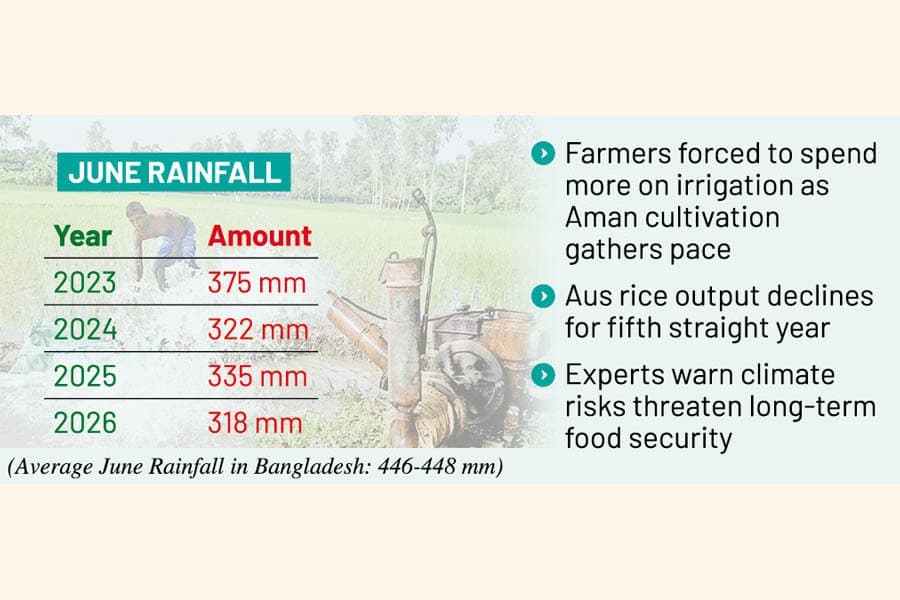
According to the Bangladesh Meteorological Department (BMD), June recorded just 318 millimetres of rainfall this year, about 29.4 per cent below the long-term average. This marks the fourth consecutive year of below-normal June rainfall, following deficits of 19.3 per cent in 2025 and lower-than-average precipitation in both 2024 and 2023.
Compounding the dry spell, three mild to moderate heat waves swept the country last month, pushing maximum temperatures between 36.5°C and 38.6°C, accompanied by persistently high humidity.
In Dhaka, relative humidity remained between 81 and 86 per cent throughout June. As the month marks the onset of the southwest monsoon, temperatures of 35°C to 36°C combined with high humidity created oppressive weather condition.
Meteorologist Dr. Sadequl Alam highlighted the increasing unpredictability of the country's weather. Rainfall in March and May remained close to normal this year, but April and June experienced unusual weather patterns, he said.
May saw near-normal rainfall at 289 millimetres, but April experienced nearly 75 per cent above-average precipitation, creating a highly erratic pattern.
"We expect weather conditions to return to near-normal during the July-September period, with rainfall likely to remain above average in July and August," Dr. Alam said.
The erratic weather has already been taking a heavy toll on farming.
The rainfall shortage has forced farmers cultivating the vital Aman rice crop to rely heavily on supplementary irrigation, said Agricultural economist Prof Dr Rashidul Islam.
He noted that farmers are now spending an extra Tk 2,000 to Tk 2,500 per bigha on irrigation, an expense that could have been avoided if timely rainfall had occurred.
Aus and Aman rice, cultivated during March-August and June-December respectively, are predominantly rain-fed crops. Insufficient rainfall during the critical April-July period can significantly reduce yields of both crops, he said.
The prolonged dry spell has also adversely affected the production of summer vegetables and fruits.
The impact is already visible in recent harvests. Government data show that Aus rice production, which accounts for around 7.0 per cent of Bangladesh's total rice output, declined for the fifth consecutive year in FY2025-26.
According to the Bangladesh Bureau of Statistics (BBS), Aus production fell to 2.7 million tonnes from 3.2 million tonnes in 2021.
Dr Md Moshiur Rahman of the Department of Agronomy at Bangladesh Agricultural University said the average Aus rice yield declined by 1.65 per cent to 2.86 tonnes per hectare, reflecting the growing impact of climate change on agricultural productivity.
He identified two key reasons behind the decline in Aus rice and summer vegetable production.
"On the one hand, farmers are gradually shifting away from Aus cultivation towards more profitable crops and other farming activities. On the other hand, average yields are falling because of increasingly erratic weather conditions," he said.
According to Dr Rahman, Bangladesh typically experiences drought conditions between March and June, followed by heavy rainfall and floods from July to September. Such irregular weather patterns have become increasingly common over the past two decades.
He also noted that cyclones have become more frequent compared with three or four decades ago.
Agricultural economist Prof Golam Hafeez Kennedy warned that the continued decline in Aus cultivation will place greater pressure on the country's two major rice seasons -- Aman and Boro -- to sustain overall rice supplies.
He said Aus rice is particularly vulnerable to erratic rainfall and other climate-ilnduced shocks.
Prof Kennedy stressed that future agricultural policy should fully incorporate climate change considerations to safeguard the country's long-term food security.
Physician and public health expert Dr Ali Hasan Md Mawla said climate change-induced weather extremes are emerging as a major public health challenge.
Prolonged heat waves during the pre-monsoon months have increased cases of heat exhaustion and heatstroke, particularly among farmers, day labourers and other outdoor workers.
At the same time, intermittent heavy rainfall followed by waterlogging has created favourable breeding conditions for Aedes mosquitoes, increasing the risk of dengue outbreaks. Stagnant water and poor sanitation have also contributed to a rise in diarrhoeal diseases and other waterborne infections.
Dr Mawla further warned that drought, floods and displacement caused by climate-related disasters can disrupt routine immunisation programmes and increase the risk of vaccine-preventable diseases such as measles.
He said that sudden fluctuations in temperature, humidity and rainfall are aggravating respiratory illnesses, skin diseases and other climate-sensitive health conditions, making climate change one of Bangladesh's most pressing public health challenges.Geographic.
tonmoy.wardad@gmail.com