


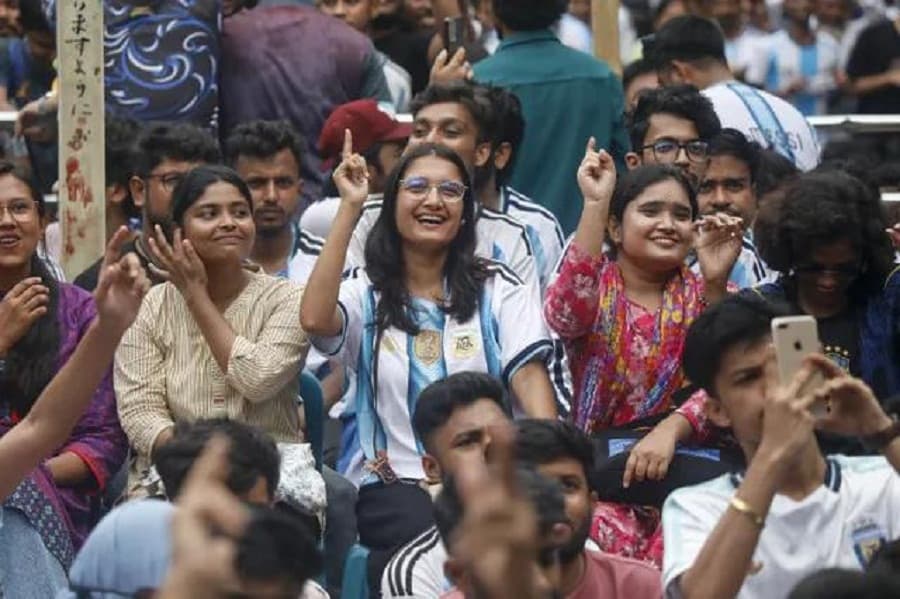
As the World Cup craze has spread like wildfire all across Bangladesh, the joy is discriminatory. Every four years, the streets of Bangladesh are draped in flags of World Cup countries, tea stalls buzz with debates about the matches, and friends and families come together to watch the global spectacle. Yet, beneath the nationwide seemingly communal celebration, for women, the joy of football comes with exclusion and scrutiny. Bangladesh breathes football, but with a gender bias. We have talked to a couple of women whose joy has been marred by prejudice and bigotry.
Auronee Sohel, an undergraduate student of LCLS, recounts her experience as a woman in the football fandom. World Cup mania runs in her family. It's a family tradition to sit together and watch the World Cup games.
She first started watching the global sport when she was only eight years old. As a die-hard Barcelona and Bayern fan, she is supporting Argentina and Spain this World Cup.
Even though she tunes in to almost every major match and keeps up with the latest news, the communal spirit of football has not really reached her.
Subjected to the stereotype that women are not authentic fans, she routinely faces condescending questions such as, "Can you name five players?" "Do you know what offside is?" and many more. It got to the point where she stopped talking about football publicly or even commenting or posting online.
Very few people treat her the same as her male counterparts in the fandom. The same male friends who bonded with her through the sport in private interactions were demeaning towards her in front of their other male peers.
Esha, a fresher at the University of Dhaka, also shared similar experiences. Unlike Auronee, Esha is a seasonal fan, meaning she only tunes in to the World Cup to watch her favourite team, Argentina, since 2022, at the age of 15.
When she first started, she remembers going to school very excited to share her newfound interest with her friends, but little did she know that not everyone would welcome her enthusiasm.
She faced mockery and very demeaning basic questions, such as, "Do you know when a point is scored?" "Do you know the job of the goalkeeper?" and such.
She came home crying, distrusting the whole sports community. But after being admitted to university and moving to Dhaka from the small town of Madaripur, she had hoped her new friends would be more welcoming.
Yet, the same prejudice haunted her there as well. Again, the same patronising questions followed, the same trauma troubled her still. These issues led her to avoid watching any football games on campus despite her newfound freedom.
The University of Dhaka's football community is known for its enthusiasm and welcoming nature. And yet, TSC didn't have any space for Esha and many other fans like her.
Female fans like her often express concerns about their safety in crowds. Why? One of her primary concerns was about her physical and psychological safety, fearing incidents of eve-teasing, groping, and other forms of harassment and exclusionary behaviour.
The 'quiz culture' has plagued the community as a whole. The bias is also very visible in the digital world. Football Fan Girls of Bangladesh, a Facebook group, conducted a survey that reveals "If a girl knows the offside rule, marry her" meme has become a cultural shorthand that treats women's football knowledge as a novelty rather than a norm. However, women's football teams have won major titles in recent times, something men have not.
UN Gender Social Norms Index (GSNI 2023) found that over 99 per cent of people in Bangladesh hold at least one bias against women. Even when some men are supportive towards women during one-to-one interactions, social pressure from a deeply patriarchal peer culture overrides it in public settings.
Backing Esha's safety concerns, 90 per cent of women aged 10–18 are harassed in public spaces. 43 per cent of women identify public spaces as the primary harassment site.
Women and girls are often not expected to have the leisure time to watch football. This institutional invisibility of women's football enjoyment is as much a product of domestic structures as it is of peer hostility.
It's also worth noting that a person's knowledge or interest in football or any other sports, for that matter, does not determine their worth, intelligence or identity, regardless of their gender.
Everyone deserves the freedom to pursue their interests to whatever extent they please, without having to prove they belong.
The perils faced by female football fans in Bangladesh are many. But the solution is very simple. Football is often called 'The world's game', but for female fans in Bangladesh, making that statement true begins by changing the larger fandom's attitude towards them.
Transforming male fans' mentality has been the primary solution sought by female fans.
The women and girls who enjoy the sport want to feel invited and included. They should not have to prove their fandom by answering silly trivia questions. They should be able to watch and enjoy the sport without fear for their safety. All they ask for is support and acceptance. The game belongs to everyone; the joy should too.
autoshyrabbani@gmail.com, and amimul225@gmail.com