


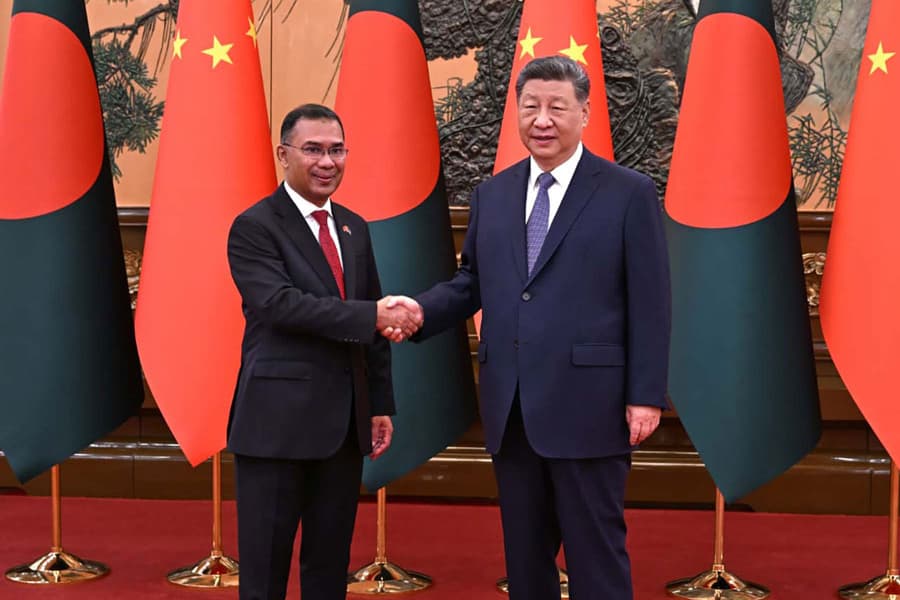
Prime Minister Tarique Rahman's China visit has understandably generated considerable enthusiasm in Bangladesh. Government leaders have portrayed the visit as a diplomatic breakthrough that ushers bilateral relations into a new era. The joint communiqué issued after the visit certainly contains several noteworthy announcements, including the elevation of bilateral ties, a new strategic dialogue mechanism, a joint feasibility study on the Teesta River Water Management Project, and Beijing's proposal for a China-Myanmar-Bangladesh Economic Corridor.
Yet, amid the celebration, a more measured assessment is warranted. Diplomacy is often about signalling intent as much as delivering immediate outcomes. The real significance of any high-level visit lies not in the number of memoranda signed or the lofty language of a communiqué, but in whether the agreements translate into tangible benefits over time.
A closer reading of the 15-point joint communiqué reveals that much of its content reiterates commitments already reflected in the communiqué issued following Chief Adviser Professor Muhammad Yunus's visit to China. Many of the commitments on trade, investment, development cooperation and people-to-people exchanges are continuation rather than entirely new initiatives.
That, however, should not reduce the importance of the visit. Diplomatic continuity is often a virtue. What matters is identifying the genuinely new elements and evaluating their strategic implications.
The first notable development is the decision to elevate bilateral relations from a "Comprehensive Strategic Cooperative Partnership" to jointly building a "China-Bangladesh community with a shared future in the new era." While the phrase carries considerable political symbolism in Chinese diplomacy, its practical implications remain to be seen. Beijing has adopted similar formulations with several partner countries as part of its broader vision of long-term strategic cooperation. Whether this upgraded relationship brings greater investment, technology transfer or market access for Bangladesh will ultimately determine its value.
Another important outcome is the agreement to establish a strategic dialogue mechanism between the two foreign ministers, alongside exploring a "2+2" dialogue involving foreign and defence officials. Such institutional mechanisms can improve communication and help manage expanding bilateral relations. However, Bangladesh will need to ensure that enhanced strategic engagement with one major power does not come at the expense of its carefully cultivated foreign policy of maintaining balanced relations with competing global actors.
The decision to initiate a joint feasibility study on the long-discussed Teesta River Comprehensive Management Project also deserves attention. For years, the Teesta issue has remained one of Bangladesh's most pressing water management challenges. While China has previously expressed interest in supporting the project, the latest announcement merely moves the initiative to the feasibility stage. Significant technical, financial and political questions remain unanswered, particularly given the river's transboundary nature.
However, the proposal that has generated the greatest interest is China's suggestion to establish a China-Myanmar-Bangladesh Economic Corridor. Although not formally incorporated into the joint communiqué, both governments acknowledged that Bangladesh would examine the proposal and assess its potential advantages and disadvantages.
This could prove to be the most consequential outcome of the visit.
From China's perspective, the logic is straightforward. A transport and economic corridor linking Yunnan Province to Myanmar and Bangladesh would shorten supply chains, improve overland connectivity to the Bay of Bengal, and diversify China's access to maritime trade routes. Such connectivity would complement Beijing's broader Belt and Road Initiative while providing strategic redundancy beyond the congested Malacca Strait.
For Bangladesh, the proposal carries both promise and complexity.
Economically, improved road, rail and logistics links could significantly reduce transportation costs and lead times with one of Bangladesh's largest trading partners. China remains the principal supplier of industrial raw materials, machinery and intermediate goods for Bangladesh's export-oriented manufacturing sector. Faster and more efficient connectivity could improve industrial competitiveness while attracting fresh investment into logistics, manufacturing and special economic zones.
A functioning corridor could also strengthen Bangladesh's ambition to become a regional connectivity hub linking South Asia and Southeast Asia. Improved infrastructure could stimulate development in the country's eastern regions while expanding access to regional markets.
Yet economics tells only part of the story.
Every transport corridor in Asia today carries geopolitical weight. Infrastructure no longer serves merely commercial objectives; it increasingly reflects strategic competition among major powers.
This is where the China-Myanmar-Bangladesh proposal becomes more sensitive.
The earlier Bangladesh-China-India-Myanmar (BCIM) Economic Corridor envisioned a broader regional framework connecting all four countries. Despite years of discussion, the initiative lost momentum largely because worsening India-China relations made meaningful cooperation increasingly difficult.
The proposed trilateral corridor effectively bypasses India. That, intentionally or otherwise, changes the regional strategic equation.
Bangladesh has consistently pursued a foreign policy centred on strategic balance. It enjoys deep economic ties with China while maintaining extensive political, security and economic cooperation with India. Any initiative perceived as tilting decisively towards one major power risks complicating this delicate equilibrium.
Some analysts have therefore suggested that Bangladesh should explore whether India could eventually be incorporated into a broader regional connectivity framework. Such an approach would preserve the economic benefits of enhanced connectivity while reducing perceptions of geopolitical exclusivity.
An inclusive regional corridor could also better complement India's own efforts to strengthen connectivity with Myanmar and Southeast Asia under its Act East policy. Rather than creating competing infrastructure networks, overlapping regional projects could reinforce one another and contribute to greater economic integration across the Bay of Bengal.
Whether such an inclusive arrangement is politically feasible is difficult to say. Current India-China relations leave little room for optimism. Nevertheless, regional connectivity tends to produce its greatest economic dividends when it remains open rather than exclusive.
There is another obstacle that receives comparatively less attention but may ultimately prove insurmountable.
No corridor can function without stability.
Myanmar continues to experience prolonged political turmoil and armed conflict following the 2021 military coup. Large parts of the country, including sections of Rakhine State, remain affected by insurgency, humanitarian crises and fragile governance. Transport infrastructure alone cannot overcome the absence of political stability and security.
Until Myanmar achieves a more predictable security environment, the commercial viability of any cross-border economic corridor will remain uncertain.
This reality reinforces why Bangladesh's cautious response is appropriate. Foreign Minister Khalilur Rahman's observation that Dhaka is examining both the advantages and the risks reflects prudent diplomacy rather than hesitation.
Infrastructure projects of this magnitude shape economic geography for decades. They deserve rigorous evaluation, transparent public discussion and careful assessment of financial sustainability, environmental impact, national security considerations and regional diplomatic consequences.
The excitement surrounding Prime Minister Tarique Rahman's China visit is understandable. Several announcements represent meaningful progress in bilateral relations, and the proposed China-Myanmar-Bangladesh Economic Corridor has the potential to reshape regional connectivity if circumstances permit.
But hype should not replace careful analysis.
The corridor offers undeniable economic opportunities. It also raises important geopolitical questions and faces significant practical obstacles. Bangladesh's challenge is neither to embrace the proposal uncritically nor reject it reflexively. Rather, it should evaluate the initiative solely through the lens of national interest, preserving its strategic autonomy while maximising economic opportunities.
Diplomacy succeeds not by choosing sides but by expanding choices. If Bangladesh can achieve that balance, the proposed corridor may eventually become more than a geopolitical headline -- it could become a genuine engine of regional prosperity.
mirmostafiz@yahoo.com