

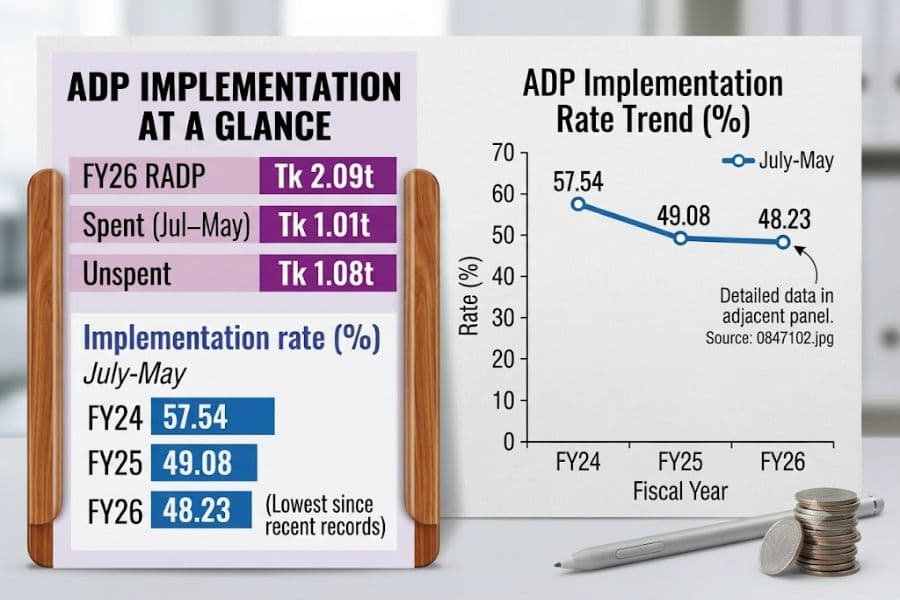
The government has spent less than half of its revised development budget even after 11 months of FY2025-26, with implementation falling to a historic low of 48.23 per cent, as project execution slowed across many ministries and agencies.
It spent only Tk 1.01 trillion out of the revised Annual Development Programme (RADP) allocation of Tk 2.09 trillion during the July-May period, data released on Thursday by the Implementation Monitoring and Evaluation Division (IMED) showed.
The performance marks the slowest pace of development expenditure in recent years, falling below the 49.08 per cent recorded during the corresponding period of FY2024-25 and significantly behind the 57.54 per cent achieved in FY2023-24.
An IMED official said weak implementation by several ministries and agencies, including the Health Services Division and the Ministry of Primary and Mass Education, contributed significantly to the record-low execution rate.
A breakdown of the 15 ministries and divisions receiving the largest allocations points to serious implementation bottlenecks in key social and infrastructure sectors.
Among the weakest performers, the Health Services Division utilised only 25.87 per cent of its Tk 31.28 billion allocation, according to IMED data.
Spending by the Ministry of Primary and Mass Education also remained sluggish, reaching just 35.18 per cent of its Tk 80.54 billion allocation.
Meanwhile, ministries and agencies struggled to utilise funds from domestic sources, spending only Tk 597.89 billion, or 46.71 per cent of the total Tk 1.28 trillion allocated under the local component.
Utilisation of project aid also remained weak, with spending reaching Tk 355.10 billion, equivalent to 49.32 per cent of the Tk 720 billion allocated under the foreign-funded component.
The pace of implementation slowed further in May. Monthly progress stood at 6.82 per cent compared with 7.77 per cent in May 2025, according to the official data.
The Road Transport and Highways Division, which received the second-largest allocation in the development budget, also performed below the overall average, utilising only 46.23 per cent of its Tk 199.49 billion allocation during the first 11 months of the fiscal year.
In contrast, a few sectors maintained relatively strong spending momentum, largely supported by ongoing energy and technology-related projects.
The Ministry of Science and Technology recorded the highest implementation rate at 83.33 per cent, spending Tk 100.24 billion during the period.
The Energy and Mineral Resources Division followed with an implementation rate of 79.48 per cent.
The Local Government Division, the largest recipient of development funds, spent Tk 255.69 billion, achieving an implementation rate of 67.81 per cent during the July-May period.
kabirhumayan10@gmail.com