




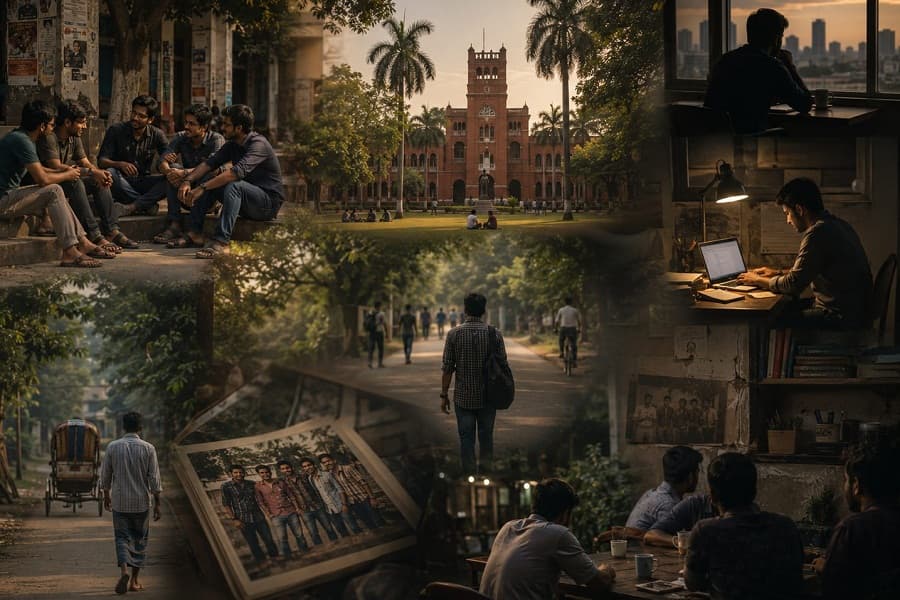
We walked into that campus certain of things we can't fully reconstruct now. Ask any of us what we thought we'd be doing by thirty and there's a pause first. Something half-embarrassed, a foreign correspondent, a scientist with a real lab, someone who was going to fix this country from the inside. We said these things in the TSC canteen, over cha that went cold because we were too busy talking, believing them the way you believe things at twenty, without evidence, mostly conviction.
One of us wanted to be a journalist, the kind with a byline people trusted. Works at a bank now. When it comes up, there's a small laugh first, not bitter, more the sound of running into someone you used to know well.
"I think I just liked the sound of it," is usually where the sentence ends.
Another wanted fieldwork, published papers, a name attached to something that mattered.
Teaches at a coaching centre now, six days a week, the same three chapters explained over and over to teenagers who mostly want the marks. There's still a stack of old journal printouts at home, yellowing in a drawer nobody opens.
A third one was going to change the country. Genuinely believed it, the way only someone at their nineteen can believe something that large without flinching. Lives abroad now, sends money home every month, comes back twice a year for weddings and funerals. Doesn't talk about changing the country anymore, not because the conviction died, but because it turned into something smaller and steadier.
Some of us decided, without saying it out loud, that this one had drifted. Got comfortable somewhere far away, stopped needing us.
We'd hear he was doing well and feel a small resentment under the relief; he's forgotten where he came from.
Nobody actually asked him. Nobody knew he still kept the group photo from second-year orientation as his lock screen, or called his mother's neighbour to check if she'd taken her evening walk.
What we read as distance was, from where he stood, just the exhaustion of building a life alone in a country that isn't his. We decided who he'd become without consulting him.
One of us went back to the village. Not by choice: a father's illness, a business that folded, a debt that needed someone physically present. Still there, running something small, answering carefully when old friends come up, guarding a past that doesn't quite fit the present.
One of us has the corporate job many envy from the outside, the title, the car, the flat in a good part of the city. The film never got made. There was a half-finished screenplay that used to come out on long weekends.
It stopped coming out, one weekend at a time, until skipping it became the default.
At reunions, people say he 'made it,' a little enviously, not knowing there's a specific grief in being congratulated for a life you didn't actually choose. Material success has a way of being loud enough to cover the one thing that's actually missing.
Some of us assumed a job like that meant something about a person that the target sheet had quietly replaced whatever softness they used to have.
It's a lazy assumption, and more than a few of us made it anyway. The truth is that plenty of them still show up. Still send money to a struggling cousin unasked. Still take a midnight call from a friend falling apart. The tenderness didn't get replaced by the job. It just stopped being visible from outside, and we mistook invisibility for absence.
There's a harder thing, one that took longer to say out loud. Back then, some of us were certain of our own politics the way only campus certainty allows, sure enough of what mattered, what counted as selling out, that we quietly wrote off a friend's choices without asking what they'd cost, someone who took the safe job instead of joining the movement.
We didn't ask whose tuition they were paying, what courage looks like when rent is due on the first.
Some of us let the friendship thin out over it, told ourselves it was a difference in values when it was really judgment we hadn't examined. Somewhere in that quiet exit, we forgot how much that person had once cared for us. The loneliness that followed wasn't really about politics. It was about a door we closed ourselves.
Then life did what it does, and some of us landed in that exact seat, the compromise we'd once judged, the quiet success mistaken for forgetting and only then understood what we hadn't bothered to ask before.
That conviction is easiest to hold when nothing of yours is at stake. By the time we understood it, there wasn't always a clean way back to say so.
We don't often visit our old selves. Visiting means admitting how far the road bent away from the one we described so confidently back then.
And yet — hardly anyone says the word regret when it comes down to it. A few say relief. Most go quiet, the way you go quiet remembering an old phone number, half-sure you could still recite it if pressed.
We weren't wrong to want those things. It just wasn't built to survive the ordinary arithmetic of family, money, and time — or the ordinary blindness of being twenty and sure you already knew who'd stopped caring, when really, no one had.
Some evenings, a few of us end up in the same room, and someone brings up those staircase conversations, and for a minute the room finds its old pitch. Then the tea goes cold, and we go back to being whoever we actually turned out to be — a little less certain, and, on the better days, calling the people we once let go, to see if it's too late.